

Growing Revenue Without Growing Your Team
What if your business could close more deals, retain more customers, and generate more leads — all without adding a single new hire?
That’s not a pipe dream. In 2026, it’s the everyday reality for thousands of businesses that have embraced AI revenue automation.
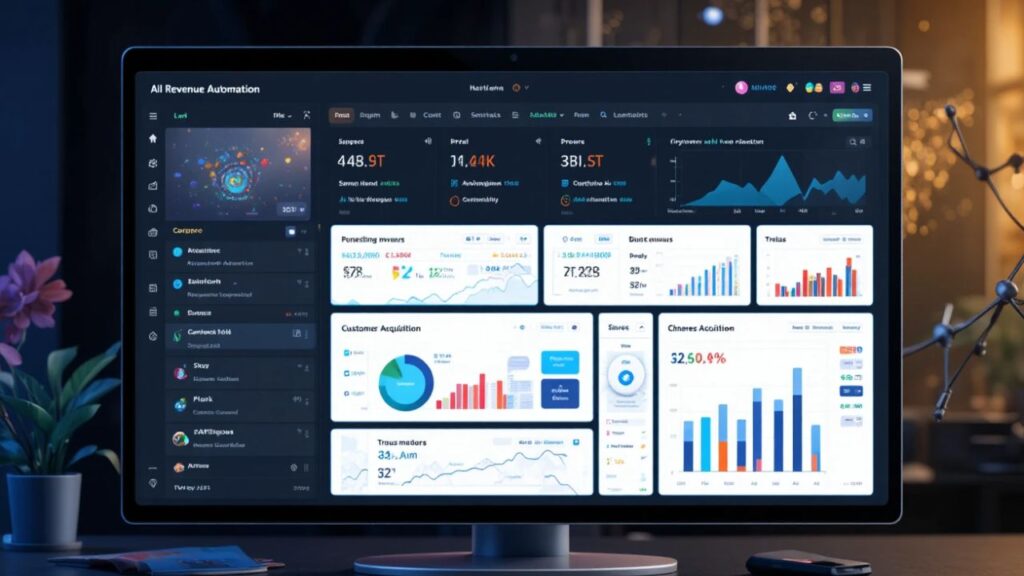
Revenue growth used to be a headcount game. Need more sales? Hire more reps. Want better customer retention? Add more support staff. But that model is expensive, slow to scale, and increasingly unnecessary. AI-powered tools now handle the repetitive, time-consuming parts of the revenue cycle — lead scoring, follow-up emails, pipeline forecasting, churn prediction — with a speed and consistency that no human team can match.
In this guide, you’ll learn exactly what AI revenue automation is, which parts of your business it can transform, what tools are leading the space in 2026, and how to start building automated revenue growth into your operations today.
What Is AI Revenue Automation?
AI revenue automation is the use of artificial intelligence to handle tasks across the revenue cycle — from lead generation and sales outreach to customer retention and upselling — with minimal manual intervention.
Unlike traditional sales automation (think: scheduled email blasts or basic CRMs), AI revenue automation is adaptive. It learns from data, personalizes interactions at scale, predicts outcomes, and continuously improves without you having to reprogram it.
The core components typically include:
- AI lead generation automation — identifying and qualifying prospects automatically
- AI sales pipeline automation — moving deals through stages based on behavior signals
- AI customer retention tools — detecting churn risk and triggering timely interventions
- Revenue operations automation — unifying data across sales, marketing, and CS teams
- AI revenue management — dynamic pricing, forecasting, and opportunity identification
According to McKinsey’s 2025 State of AI report, companies that deploy AI across their revenue functions see a 15–40% improvement in sales productivity and a measurable reduction in customer acquisition costs. That’s not marginal. That’s transformational.
How AI Sales Automation Is Replacing Manual Revenue Work
Lead Scoring and Qualification
One of the biggest time drains for any sales team is sorting good leads from bad ones. Traditional lead scoring relies on static rules — if a prospect visited your pricing page, give them 10 points. If they downloaded an ebook, give them 5. This approach misses nuance and doesn’t adapt over time.
AI lead generation automation flips this model. Instead of static rules, AI models analyze hundreds of behavioral, firmographic, and intent signals simultaneously — past purchase patterns, email engagement rates, web session behavior, technographic data, LinkedIn activity — and score leads dynamically based on what actually predicts conversion in your specific business.
The result? Sales reps spend their time on the leads most likely to close, not the ones who just happened to download a whitepaper three months ago.
Tools like Salesforce Einstein, HubSpot AI, and 6sense are doing this at scale in 2026, and many mid-market companies are building custom models using their own CRM data.
Automated Outreach and Follow-Up
Most deals don’t die because of bad products or wrong-fit prospects. They die because no one followed up at the right moment.
AI sales automation tools now handle the entire follow-up sequence — sending personalized emails, scheduling calls, logging responses, and adjusting messaging based on how a prospect engages. Platforms like Outreach, Apollo.io, and Salesloft use AI to determine the optimal send time, message tone, and call-to-action for each individual prospect.
More importantly, modern AI-powered sales tools don’t just automate the mechanics — they personalize the content. Rather than sending the same template to 500 leads, AI generates contextually relevant messages based on each prospect’s industry, pain points, recent company news, and position in the funnel.
Pipeline Forecasting and Deal Intelligence
Inaccurate sales forecasting is one of the most costly problems in revenue operations. When leadership doesn’t know which deals will close, resource planning becomes guesswork.
AI sales pipeline automation tools like Clari, Gong, and Chorus analyze deal health in real time — conversation intelligence from calls, email engagement patterns, CRM activity gaps — and surface deals at risk before they slip. Instead of asking a rep “how’s that deal looking?” and getting an optimistic gut-feel answer, managers get an AI-generated probability score backed by data.
This transforms pipeline reviews from backward-looking status updates into forward-looking strategic conversations.
AI Customer Retention: The Revenue You’re Already Leaving on the Table
Acquiring a new customer costs five to seven times more than keeping an existing one. Yet most businesses invest the bulk of their resources in acquisition and treat retention as reactive — only responding when a customer complains or cancels.
AI customer retention tools flip this. By analyzing usage data, engagement patterns, support ticket sentiment, and renewal history, AI can identify customers at high churn risk weeks or even months before they actually leave — giving your team time to intervene.
Predictive Churn Models
Tools like Gainsight, ChurnZero, and Totango use machine learning models trained on historical customer behavior to assign each account a health score. When a customer’s score drops below a threshold, it triggers an automated workflow — a check-in email, a product tutorial recommendation, or an alert to the account manager.
AI-Powered Upsell and Cross-Sell
Beyond preventing churn, AI can identify expansion opportunities within your existing customer base. By analyzing usage data and comparing it against the patterns of customers who upgraded, AI surfaces upsell recommendations at the right moment — when a customer is actively getting value, not when they’re frustrated.
This is automated revenue growth working quietly in the background, turning your existing customers into a sustainable source of incremental income.
Revenue Operations Automation: Breaking Down the Silos
One of the biggest hidden costs in most businesses isn’t a specific process — it’s the friction between processes. Sales doesn’t have full visibility into marketing’s lead quality. Customer success doesn’t know what promises were made during the sale. Finance is working with last week’s data while reps are closing deals today.
Revenue operations automation — often called RevOps — uses AI to create a unified data layer across all customer-facing teams. Every touchpoint, every conversation, every conversion is captured, analyzed, and made accessible in real time.
What RevOps Automation Looks Like in Practice
- A new deal enters the pipeline → CRM is automatically updated, the relevant playbook is triggered, and the finance team’s forecast adjusts in real time
- A customer logs a support ticket → CS is alerted, usage data is reviewed automatically, and if churn risk is detected, account management is looped in
- A campaign goes live → lead scoring updates within hours based on new engagement data, and sales reps get a prioritized list of who to call first
Platforms like Salesforce Revenue Cloud, HubSpot Operations Hub, and Zapier’s AI workflows make this kind of integration possible without requiring an army of developers.
Choosing the Right Revenue Automation Software: What to Look For
Not all revenue automation software is created equal. Here’s a framework for evaluating what’s right for your business:
1. Data Integration Depth
The value of AI is entirely dependent on the quality and quantity of data it can access. Before choosing a platform, map out where your customer data lives — CRM, marketing automation, billing system, product analytics, support desk — and confirm your tool can connect to all of it.
2. Customization vs. Out-of-the-Box Speed
Some businesses need deep customization (building proprietary models on their own data). Others need fast deployment with sensible defaults. Enterprise companies might lean toward platforms like Salesforce or Microsoft Dynamics. Smaller and mid-market businesses often get faster ROI from tools like HubSpot, Apollo, or Pipedrive’s AI features.
3. Explainability and Human Oversight
AI recommendations are only useful if your team understands why they’re being made and trusts them enough to act. Look for tools that surface reasoning alongside recommendations — not just “this deal is at risk” but “this deal is at risk because email engagement dropped 80% over the past two weeks and the champion contact hasn’t responded in 14 days.”
4. Compliance and Data Privacy
Particularly for businesses handling customer data in regulated industries or regions, ensure your revenue automation software complies with GDPR, CCPA, and any sector-specific requirements.
Real-World Results: What Businesses Are Achieving with AI Revenue Automation
The results businesses are reporting from AI-powered revenue automation aren’t marginal improvements — they’re structural shifts:
- A SaaS company with 30 sales reps implemented AI sales pipeline automation and reduced their average sales cycle from 47 days to 31 days, without adding headcount.
- A mid-market e-commerce brand deployed AI customer retention tools and reduced monthly churn from 4.2% to 2.8% in six months — the equivalent of retaining hundreds of customers they would have previously lost.
- A B2B services firm used AI lead generation automation to increase qualified lead volume by 60% while cutting their cost per lead by nearly half.
- A subscription business used AI revenue management for dynamic pricing and saw a 12% lift in average revenue per user over two quarters.
These aren’t enterprise-only outcomes. Mid-market and even small businesses are achieving similar results as the tools become more accessible and easier to implement.
Getting Started with AI Business Automation: A Practical Roadmap
If you’re new to AI revenue automation, the biggest mistake is trying to automate everything at once. Start narrow, prove value, then expand.
Step 1 — Audit your revenue bottlenecks. Where does revenue leak? Too many unqualified leads? Poor follow-up consistency? High churn rates? Identify your top two or three pain points.
Step 2 — Pick one process to automate first. Lead scoring is often the best starting point because it delivers immediate, measurable impact and doesn’t require you to overhaul your entire sales process.
Step 3 — Choose tools that integrate with what you already use. The best AI tool is the one your team actually uses. Minimize friction by selecting platforms that plug into your existing CRM and communication stack.
Step 4 — Set clear success metrics before you launch. Revenue automation without measurement is just expensive noise. Define what success looks like — conversion rate improvement, cycle length reduction, churn decrease — before you start.
Step 5 — Review and iterate monthly. AI models improve over time, but only if you feed them feedback. Review recommendations against actual outcomes regularly and work with your vendor to refine the model.

Frequently Asked Questions About AI Revenue Automation
What is AI revenue automation and how does it work?
AI revenue automation is the use of machine learning and artificial intelligence to handle repetitive tasks across the sales, marketing, and customer success functions — including lead scoring, outreach personalization, pipeline forecasting, churn prediction, and revenue reporting. It works by ingesting data from multiple systems, identifying patterns, and triggering actions or recommendations automatically, reducing the need for manual intervention at each step.
Is AI revenue automation only for large enterprises?
No. While enterprise platforms like Salesforce Einstein and Microsoft Dynamics 365 target larger organizations, there are highly capable tools built specifically for small and mid-market businesses — including HubSpot’s AI features, Apollo.io, Pipedrive AI, and Gong Engage. Many of these tools offer entry-level pricing that makes AI-powered revenue automation accessible to businesses with small sales teams and limited technical resources.
How long does it take to see results from revenue automation software?
Most businesses see early signals within 30–60 days of deployment — particularly in areas like lead prioritization and follow-up efficiency. Deeper outcomes like measurable churn reduction or significant pipeline improvement typically emerge within three to six months, as the AI models accumulate enough data to make accurate predictions.
Will AI sales automation replace my sales team?
No. AI handles the repetitive, data-intensive tasks that slow your team down — lead scoring, data entry, follow-up scheduling, meeting prep. It frees your human reps to focus on the high-judgment work that actually wins deals: building relationships, understanding complex buyer needs, and navigating stakeholder dynamics. The most effective implementations treat AI as a co-pilot, not a replacement.
What data does AI revenue automation need to be effective?
The more historical data you have, the better. At a minimum, AI revenue tools need access to your CRM data (contact records, deal history, activity logs), email engagement data, and if possible, product usage data. Businesses that connect multiple data sources — marketing, sales, billing, support — get significantly better model performance than those with siloed inputs.
Conclusion: The Revenue Advantage Goes to Those Who Automate
In 2026, the gap between businesses using AI revenue automation and those that aren’t is becoming impossible to ignore. The companies growing fastest aren’t necessarily the ones with the largest teams or the biggest budgets — they’re the ones that have systematically removed friction from their revenue process and let AI handle what AI does best.
If you’ve been waiting for AI to prove itself before investing, that time has passed. The tools are mature, the ROI is documented, and the barrier to entry is lower than it’s ever been.
The best place to start is identifying where your biggest revenue leak is right now — and finding the AI-powered solution designed to plug it.
Ready to explore your options? Start by auditing one part of your revenue process this week — lead response time, follow-up consistency, or churn alerts — and research one AI tool built specifically for that problem. Small experiments compound into significant competitive advantages.
Best Ai Personal Assistant Tools in 2026

Founder of Aivexify
Himanshu Deora is an AI tools researcher and digital publisher who tests AI software, automation tools, and emerging technology trends and AI content creator passionate about sharing helpful guides, AI tools, software tutorials, and the latest digital trends. Through Aivexify, he helps readers discover smart technology, productivity tools, and practical online resources in a simple and easy-to-understand way.