

Running a business today means juggling a dozen priorities at once — sales, hiring, marketing, customer service — and somewhere in the middle of all that sits accounting. For decades, bookkeeping and financial management have been treated as a necessary chore: time-consuming, detail-heavy, and prone to the kind of small human errors that can snowball into big problems come tax season. That’s changing fast. AI accounting software is quietly becoming one of the most impactful tools a modern business can adopt, and if you run a company in the US, UK, Canada, Australia, or anywhere else with a mature digital economy, it’s worth understanding exactly what this technology does and why it matters.
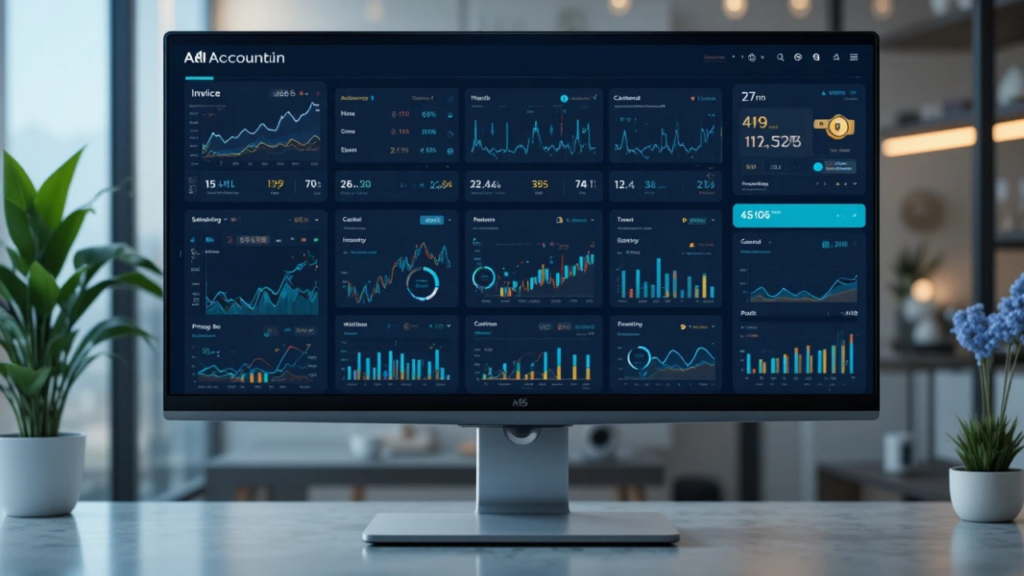
This article walks through what AI accounting software actually is, how it differs from the accounting tools you may already be using, the real benefits it brings to small and mid-sized businesses, what to look for when choosing a platform, and where this technology is headed next.
What Is AI Accounting Software, Exactly?
AI accounting software refers to financial management platforms that use artificial intelligence — machine learning, natural language processing, and predictive analytics — to automate and improve tasks that were traditionally done manually or with basic rule-based software.
Traditional accounting software (think early versions of QuickBooks or Excel-based bookkeeping) requires a person to input data, categorize transactions, reconcile accounts, and generate reports largely by hand. AI-powered platforms flip that model. Instead of you telling the software what to do at every step, the software learns from patterns in your financial data and starts making intelligent suggestions — or handling entire processes — on its own.
In practical terms, this might look like:
- Automatically categorizing thousands of bank transactions with minimal human review
- Flagging an invoice that looks unusual compared to your typical spending patterns
- Predicting cash flow shortages weeks before they happen
- Reading and extracting data from scanned receipts or PDF invoices without manual entry
- Answering plain-English questions like “How much did we spend on marketing last quarter?”
The core shift is this: AI accounting software doesn’t just record what happened financially — it helps you understand it, predict it, and act on it.
Why This Matters Now
A few converging trends have made this the right moment for businesses to pay attention to AI in accounting.
Labor costs and talent shortages. Skilled bookkeepers and accountants are in short supply in many developed economies, and hiring one — or an entire finance team — is expensive. AI tools let smaller businesses do more with leaner teams, and let larger finance departments redirect their people toward strategic work instead of data entry.
Rising expectations for real-time information. Business owners no longer want to wait until month-end to know how the company is performing. AI accounting platforms sync with bank feeds, payment processors, and e-commerce platforms to deliver up-to-the-minute financial visibility.
Regulatory complexity. Between evolving tax codes, e-invoicing mandates, and reporting standards in countries like the UK (Making Tax Digital), Australia (Single Touch Payroll), and the EU (e-invoicing directives), staying compliant manually is harder than ever. AI systems are increasingly built to keep pace with these changes automatically.
Data volume. As businesses grow, so does the sheer volume of transactions, vendors, and financial documents. Human bookkeeping simply doesn’t scale as efficiently as an AI system that can process thousands of data points in seconds.
The Real Benefits of AI Accounting Software
1. Dramatic Time Savings
The most immediate benefit business owners notice is how much time they get back. Tasks that used to take hours — reconciling bank statements, chasing down receipts, categorizing expenses — can now happen automatically in the background. Many businesses report cutting the time spent on routine bookkeeping tasks by 50% or more after adopting an AI-driven platform.
2. Fewer Costly Errors
Manual data entry is one of the leading causes of accounting mistakes, and even small errors can lead to inaccurate financial statements, missed tax deductions, or compliance issues. AI systems are far less prone to the fatigue-driven mistakes humans make, and many platforms include built-in anomaly detection that flags entries needing a second look before they become a bigger problem.
3. Better Cash Flow Forecasting
Cash flow issues are one of the most common reasons small businesses struggle. AI accounting tools analyze historical income and expense patterns to forecast future cash positions, helping business owners anticipate shortfalls and plan accordingly — rather than being surprised by them.
4. Fraud and Anomaly Detection
Because AI models learn what “normal” financial activity looks like for your business, they’re well-suited to catching what’s abnormal. This includes duplicate invoices, unusual vendor payments, or transactions that don’t match typical patterns — often catching issues a human reviewer might miss simply due to volume.
5. Faster, Easier Financial Reporting
Instead of manually building profit-and-loss statements or balance sheets, AI accounting platforms generate these reports automatically, often with natural-language summaries that explain what changed and why. Some tools now let you simply ask a question — “Why did expenses go up in March?” — and get a plain-English answer backed by the underlying data.
6. Improved Compliance and Tax Readiness
AI platforms increasingly stay updated with local tax rules and reporting requirements, which is especially valuable in countries with frequent regulatory changes. This reduces the risk of penalties and makes tax season significantly less stressful, since much of the categorization and documentation work has already been done throughout the year.
7. Scalability Without Proportional Overhead
One of the more underrated benefits is how well AI accounting software scales. A business that grows from handling 500 transactions a month to 5,000 doesn’t need to hire five times as many bookkeepers — the software absorbs much of that additional volume.
Common Features to Look For
If you’re evaluating AI accounting software for your business, here are the capabilities worth prioritizing:
Bank and platform integrations. The software should connect directly to your business bank accounts, credit cards, payment processors (Stripe, PayPal, Square), and e-commerce platforms to pull in data automatically rather than requiring manual uploads.
Automated transaction categorization. Look for a system that learns your business’s specific spending categories over time and improves its accuracy the longer you use it.
Optical character recognition (OCR) for receipts and invoices. This allows the software to read physical or scanned documents and extract the relevant data automatically, eliminating manual entry.
Predictive cash flow tools. Not all platforms offer forecasting, so if this is a priority, confirm it’s included and check how far ahead the predictions extend.
Natural language querying. Increasingly, platforms let you type or speak questions about your finances and receive direct answers, which is especially useful for business owners without a finance background.
Audit trail and anomaly alerts. A good system flags unusual transactions and maintains a clear, timestamped record of changes for compliance and audit purposes.
Multi-currency and multi-entity support. For businesses operating across borders — common among growing companies in the US, UK, EU, and Australia — this is essential rather than optional.
Integration with payroll and tax filing. The best platforms don’t operate in isolation; they connect with payroll systems and can either handle tax filing directly or export clean data for your accountant.
Who Benefits Most From AI Accounting Software?
Small business owners who don’t have the budget for a full in-house finance team benefit enormously, since AI tools essentially act as a tireless junior bookkeeper working around the clock.
Freelancers and solopreneurs gain from the sheer time savings — no more spending weekends sorting through receipts.
Growing mid-sized companies benefit from the scalability, since transaction volume can increase substantially without a proportional increase in accounting overhead.
Accounting firms and bookkeepers themselves are increasingly adopting these tools not to replace their expertise, but to handle the repetitive parts of the job so they can focus on advisory work — the strategic conversations clients actually value most.
It’s worth noting that AI accounting software isn’t designed to eliminate the accountant or bookkeeper from the picture. Rather, it changes their role from data-entry clerk to financial advisor. Judgment calls, strategic tax planning, and nuanced interpretation of financial data still benefit enormously from human expertise — AI handles the volume and repetition, while people handle the strategy.
Things to Consider Before Adopting AI Accounting Software
Data security and privacy. Since these platforms handle sensitive financial data, confirm the provider uses strong encryption, complies with relevant data protection regulations (such as GDPR in the UK/EU or equivalent frameworks in the US, Canada, and Australia), and has a solid track record on security.
Accuracy still requires oversight. AI is highly capable but not infallible. Especially in the early months of use, it’s wise to review categorizations and flagged anomalies rather than assuming the system is perfect from day one.
Integration with existing tools. Check compatibility with your current payroll provider, point-of-sale system, CRM, and any industry-specific software you already rely on.
Learning curve. While many platforms are designed to be intuitive, transitioning from a manual or semi-manual system does require some setup time and a period of adjustment for your team.
Cost versus value. Pricing varies widely, from affordable plans suited to freelancers to enterprise-tier platforms built for larger organizations. Weigh the subscription cost against the time and error-reduction savings you’re likely to see.
The Road Ahead
AI accounting software is still evolving quickly, and a few trends are worth watching:
Deeper predictive capabilities. Beyond basic cash flow forecasting, expect tools that model different business scenarios — what happens if you hire two more employees, or if a major client pays 30 days late.
Conversational finance assistants. The ability to simply ask your accounting software questions in plain English is becoming a standard feature rather than a novelty, making financial data accessible to non-finance staff.
Tighter regulatory integration. As governments in the US, UK, EU, and Australia continue rolling out digital tax initiatives, expect AI platforms to build in real-time compliance checks and automated filing capabilities.
Autonomous bookkeeping. Some platforms are moving toward fully autonomous month-end closes, where the AI handles reconciliation, categorization, and reporting with minimal human intervention, flagging only genuine exceptions for review.

Final Thoughts
AI accounting software represents one of the more practical, immediately useful applications of artificial intelligence for everyday businesses. It doesn’t require a background in data science or machine learning to benefit from — it simply requires a willingness to let technology handle the repetitive, error-prone parts of financial management so you and your team can focus on the decisions that actually move your business forward.
Whether you’re a solo freelancer trying to reclaim your weekends, a small business owner tired of chasing receipts, or a finance leader looking to scale operations without scaling headcount, there’s a strong case for exploring what AI accounting tools can do for you. As with any technology decision, the key is choosing a platform that fits your specific business needs, integrates well with your existing systems, and — perhaps most importantly — one that you and your team will actually trust and use consistently.
The businesses that get ahead of this shift now are likely to find themselves with cleaner books, better financial visibility, and more time to focus on growth — while their competitors are still buried in spreadsheets.
Ai GitHub Tools

Founder of Aivexify
Himanshu Deora is an AI tools researcher and digital publisher who tests AI software, automation tools, and emerging technology trends and AI content creator passionate about sharing helpful guides, AI tools, software tutorials, and the latest digital trends. Through Aivexify, he helps readers discover smart technology, productivity tools, and practical online resources in a simple and easy-to-understand way.