
What if instead of asking one AI to do everything, you could deploy a whole team of AI agents — each specialized, each focused, all working in sync?
That’s exactly what multi-agent systems make possible. And in 2026, they’re no longer a research concept. They’re running inside enterprise workflows, powering autonomous research pipelines, and quietly handling tasks that would overwhelm even the most capable single AI model.
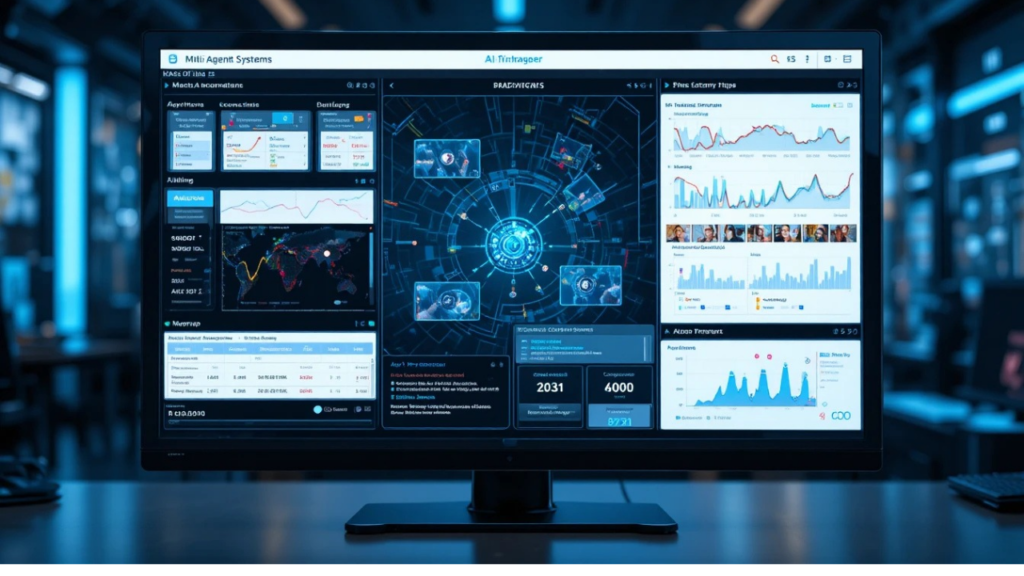
In this guide, you’ll learn what multi-agent AI systems are, how they work under the hood, what makes them so powerful, and — critically — what actually breaks when you build or deploy them in the real world. Whether you’re a business leader, a developer, or simply someone trying to make sense of where AI is heading, this breakdown is for you.
What Are Multi-Agent Systems? A Simple Definition
A multi-agent system (MAS) is a framework in which multiple AI agents operate together — each with its own role, reasoning capability, and set of tools — to accomplish tasks that are too complex, too large, or too multifaceted for a single model to handle alone.
Think of it like a company. No single employee does everything. You have a sales team, a finance team, engineers, and managers. Each group has a defined function. They communicate, hand off tasks, check each other’s work, and collectively achieve goals no individual could accomplish solo.
Multi-agent AI systems work the same way. One agent might browse the web for information. Another analyzes that data. A third writes a report. A fourth reviews it for accuracy. All of this happens automatically, with minimal human intervention.
Quick Answer: A multi-agent system is a network of AI agents that communicate and collaborate to complete complex tasks, with each agent handling a specific function within a shared workflow.
How Do AI Agents Work Together? Understanding the Architecture
To understand multi-agent AI architecture, it helps to break it into three core layers:
1. The Orchestrator (The Manager)
Every multi-agent system needs a coordinator — often called an orchestrator or planner agent. This agent receives the high-level goal, breaks it into subtasks, assigns those subtasks to the right agents, and monitors progress. Think of it as the project manager of the system.
Modern AI orchestration platforms like LangGraph, AutoGen, and CrewAI provide the scaffolding to build these orchestrators without starting from scratch.
2. Specialist Agents (The Team Members)
Under the orchestrator, you have a set of specialist agents — each built or prompted to excel at a specific function:
- A research agent that searches the web and retrieves information
- A coding agent that writes, tests, and debugs software
- A summarizer agent that condenses long documents into key insights
- A validator agent that fact-checks outputs before they’re used
Each agent operates with its own context, tools, and memory. They’re like departments within a company: focused, efficient, and accountable.
3. Agent-to-Agent Communication
The glue holding everything together is agent-to-agent communication. Agents pass messages, share outputs, and trigger each other’s actions through structured protocols. Some systems use simple message queues. Others use shared memory stores or tool-call chains.
This communication is what transforms a collection of individual models into a genuinely cooperative AI system.
A Real-World Example: How 4 AI Agents Write a Blog Post
Understanding the architecture in theory is one thing. Seeing it in action is another. Here’s a concrete example of an agentic AI workflow used to produce a research-backed blog post — entirely autonomously.
Agent 1 — Research Agent Receives the topic and target keyword. Searches the web for the top 10 ranking articles, extracts key claims, statistics, and recurring subtopics. Outputs a structured research brief.
↓
Agent 2 — Outline Agent Reads the research brief. Identifies gaps in what competitors cover. Creates a detailed content outline with H2/H3 structure optimized for search intent.
↓
Agent 3 — Writing Agent Takes the outline and research brief. Writes a full draft in the specified tone and word count. Does not search — it works only from the provided context to stay fast and focused.
↓
Agent 4 — Fact-Check and QA Agent Reads the finished draft. Cross-references specific claims against the original research brief. Flags anything unsupported, overstated, or inconsistent. Returns a list of corrections.
The orchestrator then either automatically applies the corrections or routes them to a human editor for a final review before publishing.
This is a real AI agent workflow running in production at content and marketing teams today. What would take a human writer 3–4 hours can run in 8–12 minutes — and the output quality, when the agents are well-configured, is genuinely competitive.
Why Multi-Agent AI Systems Outperform Single Models
A reasonable question: if AI models like Claude or GPT-4o are already powerful, why bother with multiple agents?
Here’s why distributed AI systems consistently outperform monolithic ones:
They overcome context window limits. A single AI model can only hold so much information in its working memory. A multi-agent system can distribute a massive task across many agents, each handling a manageable chunk. Research from Anthropic on long-context tasks shows that even large-context models perform better when complex tasks are broken into focused subtasks.
They enable parallelism. Multiple agents can work simultaneously rather than sequentially. A pipeline that would take one agent an hour might take a team of five agents fifteen minutes.
They allow specialization. A generalist model is decent at everything. A specialist agent, fine-tuned or prompted for a specific task, is excellent at one thing. Multi-agent frameworks let you combine many specialists.
They support error-checking. One agent can validate another’s work — a built-in quality control mechanism that single-model systems lack by default. Microsoft Research’s AutoGen paper demonstrated that agent-to-agent review loops significantly reduced error rates in code generation tasks compared to single-model outputs.
They scale naturally. Adding more agents to handle additional workload is far more practical than trying to squeeze more out of a single model.
What Actually Happens When You Build With Multi-Agent Systems
This is the section most articles skip. Knowing the theory is useful. Knowing what breaks in practice is essential.
Token Costs Spiral Faster Than You Expect
Each agent call is a separate API request. A five-agent pipeline might make 20–40 LLM calls to complete a single task — especially when agents loop back for clarification or validation. On complex workflows, what seems like a cheap automation can rack up significant token costs at scale. Batching, caching repeated lookups, and using smaller models for low-stakes subtasks are non-negotiable optimizations.
Agents Can Loop Indefinitely
Without hard limits on retries and recursion depth, agents get stuck. A research agent that can’t find a source keeps searching. A validator that’s uncertain keeps asking the writer to revise. Real systems need explicit loop-break conditions and fallback paths — otherwise a single stuck agent can freeze the entire pipeline.
Hallucination Chains Are a Real Problem
In a multi-agent workflow, one agent’s hallucinated “fact” becomes the next agent’s ground truth. By the time a validator reviews the output, the error has been cited, paraphrased, and woven into three other sections. This is called hallucination propagation and it’s the failure mode that catches the most teams off guard. The fix is grounding research agents in verified sources and building validators that check claims against the original source material — not just the previous agent’s output.
Debugging Is Non-Linear
When something goes wrong in a single-model system, you trace one input/output pair. In a multi-agent pipeline, you’re tracing a conversation across five agents, each with its own state. Good observability tooling — LangSmith, Langfuse, or similar — isn’t optional in production. It’s the difference between a 10-minute debug and a 3-hour one.
Real-World Multi-Agent AI Use Cases in 2026
Multi-agent systems are no longer theoretical. Here are some of the highest-impact applications running today:
Enterprise Research and Analysis
Large organizations are deploying autonomous agent networks to conduct market research, competitive analysis, and regulatory monitoring. One agent scrapes sources. Another filters for relevance. A third synthesizes findings into a structured report. What used to take a team of analysts days can now happen overnight.
Software Development Pipelines
Intelligent agent systems are transforming how software gets built. A planning agent reads the product specification. A coding agent writes the feature. A testing agent runs unit tests. A documentation agent writes the README. GitHub’s research on Copilot Workspace — a multi-agent coding environment — showed meaningful reductions in the time developers spend on routine implementation tasks.
AI Customer Support Automation
Cooperative AI agents handle complex support flows: a triage agent categorizes the query, a knowledge-retrieval agent pulls the most relevant documentation, a response agent drafts the reply, and a tone-checking agent ensures it’s on-brand. The result is faster, more consistent support at scale without proportional headcount growth. (See our guide on [AI Customer Support Automation] for a deeper breakdown.)
Legal and Compliance Review
Law firms and compliance teams are using multi-agent workflow automation to review contracts, flag potential risks, and cross-reference regulatory databases — dramatically reducing the manual hours required for due diligence.
AI for Sales Teams and CRM Automation
Enterprise AI agents are being wired into CRM systems to qualify leads, draft outreach sequences, update deal records after calls, and surface next-best-action recommendations — all without a rep manually logging anything. (Related: [AI CRM Automation] and [AI for Sales Teams].)
Framework Comparison: Which Multi-Agent Platform Should You Use?
If you’re exploring how to build with multi-agent AI, here are the five most widely used frameworks in 2026 — and how they compare:
| Framework | Best For | Technical Difficulty | Maturity |
| LangGraph | Production systems, complex branching workflows | High | Production-ready |
| CrewAI | Fast setup, role-based pipelines | Low | Production-ready |
| AutoGen (Microsoft) | Research, conversational agent experiments | Medium | Maturing |
| OpenAI Swarm | Learning agent handoffs, lightweight experiments | Low | Experimental |
| Anthropic MCP | Standardizing tool access across any framework | Medium | Widely adopted |
LangGraph is the most powerful option for teams that need fine-grained control over agent state, conditional routing, and production reliability. The learning curve is steep but the architecture pays off at scale.
CrewAI is the fastest path from idea to working pipeline. You define agents by role (like “SEO Researcher” or “Content Editor”), assign tools, and the framework handles orchestration. Ideal for content, marketing, and operations use cases.
AutoGen shines in research settings where you want agents to debate, critique, and iterate on each other’s outputs in a conversational format. Less suited for rigid production pipelines.
OpenAI Swarm is explicitly experimental and best used for learning how agent handoffs work — not for shipping to customers.
Anthropic’s Model Context Protocol (MCP) isn’t a full framework but a standardized protocol for giving agents access to tools and external data. It’s become widely adopted across all the frameworks above as a way to connect agents to services like web browsers, databases, and APIs.
Key Challenges in Multi-Agent AI Systems
Beyond the practitioner lessons above, here are the structural challenges every team encounters:
Reliability and error propagation. If one agent in a chain produces a bad output, downstream agents amplify the mistake. Robust validation steps and human-in-the-loop checkpoints are essential.
Latency. Sequential agent pipelines add latency at each step. A five-agent chain where each agent takes 8 seconds means 40+ seconds end-to-end — which matters in real-time applications.
Trust and safety. Autonomous agent networks that take real-world actions — sending emails, executing code, making API calls — require careful permission scoping. Anthropic’s research on AI safety emphasizes the importance of minimal-privilege architectures where agents only have access to the tools they strictly need.

FAQ: Multi-Agent Systems Explained
Q: What is the difference between a single AI model and a multi-agent system?
A single AI model takes an input and produces an output in one step. A multi-agent system routes tasks through multiple specialized agents that communicate, collaborate, and build on each other’s outputs — enabling far more complex and scalable workflows.
Q: What are the best multi-agent AI examples for beginners to understand?
The clearest example is the content pipeline described above: one agent researches, one outlines, one writes, one reviews. Another accessible example is a customer support flow where different agents handle triage, retrieval, drafting, and quality checks. Both illustrate the core pattern — specialization plus handoffs.
Q: Do multi-agent AI systems require coding to set up?
It depends on the platform. Developer-focused frameworks like LangGraph require Python knowledge. However, no-code and low-code tools are emerging that let non-technical users build agent workflows through visual interfaces.
Q: Are multi-agent systems the same as AI automation?
Not exactly. Traditional AI automation executes predefined rules. Multi-agent systems involve agents that reason, make decisions, use tools, and adapt — making them more flexible and capable than rule-based automation.
Q: How do I prevent hallucinations in a multi-agent pipeline?
Ground your research agents in verified sources rather than letting them generate facts from memory. Build a dedicated validator agent that cross-references claims against the original source material. Never let one agent’s unverified output become another agent’s authoritative input without a grounding step in between.
Conclusion: The Future Belongs to Teams of AI Agents
We’re in the early days of a major shift. Single AI models — impressive as they are — are giving way to coordinated networks of agents that plan, specialize, collaborate, and self-correct. Multi-agent systems represent the next frontier of practical AI: not smarter models in isolation, but smarter systems built from models working in concert.
For businesses, this means rethinking automation not as a single tool but as a distributed team. For developers, it means designing systems that are modular, observable, and resilient — with hard limits, fallback paths, and proper observability baked in from day one. For everyone else, it means the AI capabilities arriving in products over the next few years will feel qualitatively different: more capable, more contextual, more autonomous.
The question isn’t whether multi-agent AI will reshape how work gets done. It already is. The question is whether you’ll be building with it — or catching up to it.
Ready to go deeper? Explore how AI orchestration platforms and enterprise multi-agent frameworks can fit into your specific workflow — or start with one of the use case guides linked throughout this article.
Ai Revenue Automation in 2026

Founder of Aivexify
Himanshu Deora is an AI tools researcher and digital publisher who tests AI software, automation tools, and emerging technology trends and AI content creator passionate about sharing helpful guides, AI tools, software tutorials, and the latest digital trends. Through Aivexify, he helps readers discover smart technology, productivity tools, and practical online resources in a simple and easy-to-understand way.