

The FIFA World Cup 2026 is one of the most-anticipated sporting events in history — the first ever to be held across three countries (the United States, Canada, and Mexico) and the first to feature 48 teams. With more matches, more upsets, and more data than ever before, millions of fans are turning to AI football prediction tools to make sense of it all.
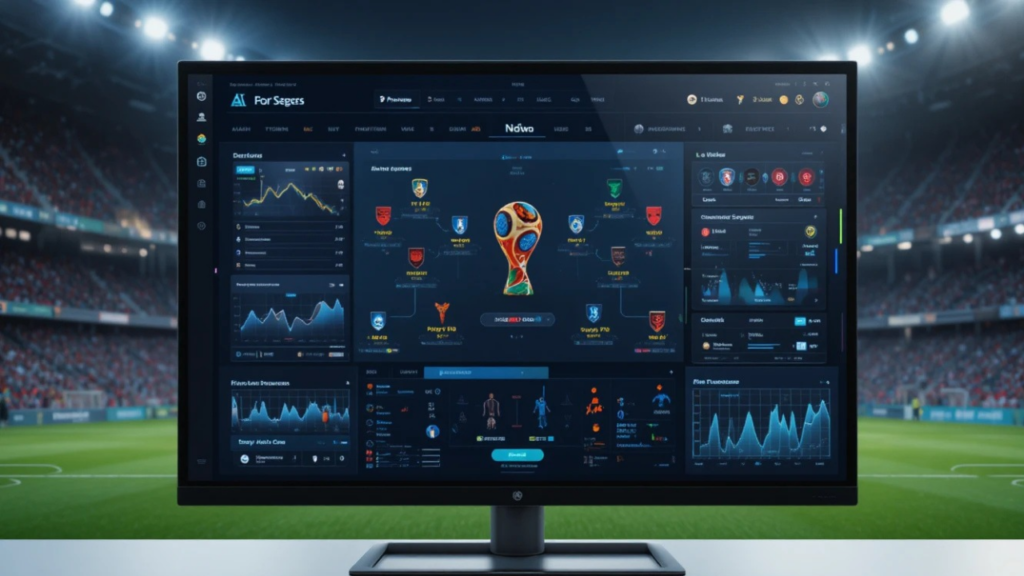
Whether you want to win your office sweepstake, make smarter fantasy football picks, or simply satisfy your curiosity about which nation will lift the trophy, artificial intelligence has fundamentally changed how we forecast the beautiful game. In this guide, you will learn exactly what the best AI tools for World Cup predictions can do, how they work, and which ones deserve a place in your matchday routine.
How AI Football Prediction Tools Actually Work
At their core, AI football prediction tools are statistical engines trained on enormous amounts of historical data. They crunch numbers that no human analyst could process in a lifetime — and they do it in seconds.
The Data Behind the Predictions
Modern AI sports prediction software ingests dozens of data streams simultaneously. These typically include historical head-to-head records going back decades, player-level performance metrics such as expected goals (xG), pressing intensity, and pass completion under pressure, team form across competitive and friendly fixtures, squad depth and injury reports, tournament bracket structure, and even psychological factors like rest days between matches and travel distance.
The most sophisticated platforms layer in Elo rating systems — originally developed for chess — alongside machine learning models that continuously update as new match results come in. Some tools even apply natural language processing to press conference transcripts and social media sentiment, looking for signals of team morale that raw statistics might miss.
From Probability to Prediction
Importantly, AI prediction tools do not tell you who will definitely win. They output probabilities. A well-calibrated model might tell you that Brazil has a 34% chance of winning the 2026 World Cup, France 18%, and England 12%. These are not guarantees — they are the best-available statistical estimates given the data at hand. The distinction matters enormously when you are using these tools to inform any kind of decision, from sweepstake choices to sports betting.
Top AI Tools for World Cup Predictions in 2026
The AI sports prediction software landscape has matured rapidly. Here are the leading platforms making noise heading into the 2026 tournament, covering a range of use cases from casual fan predictions to data-driven research.
1. Opta AI & Stats Perform
Stats Perform’s Opta division is arguably the gold standard in professional football data. Their AI models power predictions for broadcasters, betting operators, and clubs worldwide. For World Cup coverage, Opta publishes win probability figures, expected line-ups, and in-play prediction updates after every significant event on the pitch. Their strength lies in the sheer depth and quality of their underlying data — they have been collecting detailed event data since 1996.
Best for: Serious analysts, journalists, and betting professionals who need reliable, granular football data.
2. Goldman Sachs Global Investment Research Models
Yes, that Goldman Sachs. The investment bank has released AI-powered World Cup prediction models for several recent tournaments using its machine learning infrastructure. Their models simulate the entire tournament hundreds of thousands of times, outputting probabilities for every possible outcome. While not a consumer product, their publicly released reports are freely accessible and make for fascinating reading — especially their methodology documents, which explain exactly how they weight player quality, coach tenure, and tournament experience.
Best for: Fans who want to understand tournament-level simulation modelling without buying a subscription.
3. FiveThirtyEight / ABC News Sports Predictions
FiveThirtyEight built its reputation on rigorous data journalism, and its club soccer and international football prediction models are among the most transparent available. Their Soccer Power Index (SPI) rates every international team and updates in near-real-time. During a World Cup, they publish match-by-match win probabilities and continuously update knockout round projections as results come in. The site is free to use and explains its methodology in plain English — a major advantage if you want to actually understand what you are looking at.
Best for: Everyday fans who want data-driven predictions delivered in an accessible, visually engaging format.
4. Betegy & AI Betting Prediction Platforms
Betegy is one of several AI sports prediction platforms specifically designed for sports bettors. It uses machine learning to generate pre-match predictions — including correct score probabilities, both teams to score likelihoods, and over/under goal markets — across hundreds of football matches weekly. For World Cup fixtures, it offers a dedicated tournament dashboard with head-to-head stats, form guides, and AI-generated confidence scores for each available market.
Best for: Bettors who want AI-assisted market analysis. Always gamble responsibly and be aware of the risks involved.
5. Soccerway & Forebet Automated Predictions
Forebet is a widely used free tool that applies mathematical and AI-driven models to predict football results. It provides an overall probability score, a recommended prediction, and recent form data in a clean, easy-to-read layout. While not as sophisticated as Opta’s enterprise offering, Forebet is a solid entry-level FIFA World Cup prediction AI resource that requires no sign-up and covers international fixtures comprehensively.
Best for: Casual fans and beginners who want a quick, free AI prediction without technical complexity.
6. Sporting Index & Exchange AI Tools
Several spread betting and betting exchange platforms now embed proprietary AI sports prediction software directly into their interfaces. These real-time tools adjust odds and predictions dynamically as a match unfolds, factoring in red cards, injuries, and momentum shifts within seconds. For in-play World Cup enthusiasts, these can offer genuinely useful contextual predictions — though they are integrated into commercial gambling products and must be approached with care.
What to Look for When Choosing an AI Football Prediction Tool
Not all AI prediction tools are created equal. Before you trust any platform with your sweepstake entry or fantasy football selections, run it through this checklist.
Transparency of Methodology
The best AI tools for World Cup predictions will tell you — at least in broad terms — how they arrive at their numbers. If a platform publishes win probabilities with no explanation of how they are calculated, treat its outputs with extra scepticism. Reputable tools like FiveThirtyEight publish detailed methodology write-ups. Look for similar transparency wherever you browse.
Track Record and Backtesting
Has the model been tested against historical World Cup data? Good prediction tools will show calibration charts or accuracy statistics from previous tournaments. A model that correctly predicted 68% of group stage outcomes at past World Cups gives you a meaningful baseline. One that simply claims ‘high accuracy’ without evidence deserves healthy scrutiny.
Data Freshness and Update Frequency
International football squads evolve constantly. Key players get injured, coaches change tactics, and late call-ups happen. The best FIFA World Cup prediction AI platforms update their models daily — or even in real time during a tournament. Stale data is one of the most common ways a theoretically sound model produces poor predictions in practice.
Coverage of Relevant Markets and Metrics
Think about what you actually need. Are you predicting group stage outcomes, looking for golden boot contenders, or trying to identify dark horse teams that might over-perform? Make sure your chosen tool covers the specific metrics that matter for your use case — goals, assists, xG, defensive metrics, set-piece effectiveness — rather than relying solely on headline win/loss probabilities.
Honest Limitations of AI World Cup Prediction Tool
Artificial intelligence is powerful — but football has a habit of humbling even the most sophisticated models. Before you put too much faith in any algorithm, here is what the data cannot fully capture.
- Rare tournament upsets: No AI model consistently predicted Germany’s 2014 7-1 thrashing of Brazil in their own backyard, or Saudi Arabia defeating Argentina 2-1 in 2022. These extreme outliers exist precisely because football is a low-scoring sport where variance matters enormously.
- Managerial and tactical surprises: If a coach deploys a system nobody has seen before in a high-stakes match, AI models trained on past data will not have seen it either. Tactical innovation is a genuine edge that humans still hold over machines.
- Psychological and situational factors: Penalty shootouts, tournament experience under pressure, crowd atmosphere in specific host cities — these are notoriously difficult to quantify. Some models attempt to incorporate them; most struggle.
- Injury timing: A key player picking up a knock in the warm-up before a quarter-final will upend any model’s pre-match probability immediately. The better platforms adjust rapidly; others do not.
None of these limitations mean AI tools are not worth using — they absolutely are. They simply mean you should treat AI outputs as one powerful input into your thinking, not as an oracle.
How to Combine AI Predictions with Your Own Football Knowledge
The sharpest football predictors — whether they are professional analysts, experienced fantasy managers, or engaged fans — treat AI sports prediction software as a research assistant, not a decision-maker. Here is a practical workflow that gets the most from these tools.
- Start with the AI baseline. Check win probabilities and form data for both teams before you form any opinion. This guards against cognitive biases — loving a team or fearing a traditional giant can cloud your judgment.
- Layer in context the model might miss. Read pre-tournament press coverage, track squad announcements, and pay attention to which players look sharp or below par in training footage. Qualitative signals can confirm or challenge what the data shows.
- Look for odds discrepancies. If an AI model gives Team A a 55% win probability but the market is pricing them as slight underdogs, something is worth investigating. Either the model has spotted something the market has not, or the market knows something the model does not — either way, it is a prompt for deeper research.
- Track your predictions across the tournament. Keep a simple spreadsheet of your predictions, the AI’s probabilities, and the actual outcomes. Over 64 matches, you will start to see patterns — and you will learn whether you consistently beat or trail the models in particular types of fixtures.
- Stay updated. The 2026 World Cup group stage alone will deliver nearly 50 matches of data. Good AI tools will update their knockout round predictions after every game. Make a habit of re-checking after major results.
Frequently Asked Questions
Q: What is the most accurate AI tool for World Cup predictions?
There is no single ‘most accurate’ tool — accuracy varies by tournament and metric. However, Opta’s Stats Perform models and FiveThirtyEight’s Soccer Power Index are consistently regarded as among the best-calibrated for international football. Both have proven track records across multiple World Cups and publish transparent methodology. For casual use, Forebet offers reliable free predictions with a straightforward interface.
Q: Can AI accurately predict football results?
AI can predict football results with meaningful accuracy at the probability level — consistently performing better than most human pundits over large samples of matches. However, no AI model can predict individual match outcomes with certainty. Football’s low-scoring nature means even heavy favourites lose regularly. The best AI tools frame predictions as probabilities (e.g., a 65% win chance for Team A) rather than definitive outcomes, and it is important to understand them on those terms.
Q: Are AI World Cup prediction tools free to use?
Many excellent AI football prediction tools are completely free. FiveThirtyEight publishes all its predictions without a paywall. Forebet provides free daily predictions. Goldman Sachs World Cup model reports are released publicly. Professional-grade tools like Opta typically require subscriptions or commercial licences, but their data is often surfaced through free media partnerships and sports coverage.
Q: How does FIFA World Cup prediction AI handle the expanded 2026 format?
The 2026 World Cup’s expansion to 48 teams introduces several new modelling challenges — more diverse nations, less historical head-to-head data for some matchups, and a new knockout format through the round of 32. The best AI sports prediction software handles this by relying more heavily on team Elo ratings and player-level quality metrics rather than just head-to-head records, which are sparse for some potential matchups between lower-ranked teams. Expect modelling uncertainty to be higher in early group matches involving less well-documented nations.
Q: Should I use AI predictions for sports betting?
AI predictions can provide useful context when evaluating betting markets, but they are not a guaranteed route to profit. The betting market is highly efficient and incorporates vast amounts of information. When an AI model and the market agree on a probability, there is no edge to exploit. The interesting cases are when they diverge significantly — and even then, you need to understand why. Always bet within your means, treat gambling as entertainment, and be aware that the house holds a long-term mathematical advantage in most sports betting markets.

Conclusion: Let AI Sharpen Your 2026 World Cup Predictions
The best AI tools for World Cup predictions are not magic — but used thoughtfully, they give you a genuine analytical edge. From the institutional rigour of Opta and FiveThirtyEight to the accessible simplicity of Forebet, there is a FIFA World Cup prediction AI platform suited to every type of football fan.
As 48 teams prepare to battle it out across North America in 2026, the sheer volume of matches makes data-driven tools more valuable than ever. Use them to challenge your assumptions, stress-test your sweepstake picks, and deepen your appreciation of what the numbers reveal — and conceal — about the beautiful game.
The algorithm might not know who scores the winner in the final. But it will give you the best available estimate of who to back — and that is a meaningful advantage in a tournament defined by glorious, unpredictable drama.
Ready to make your World Cup 2026 predictions?
Bookmark this guide, explore the AI tools listed above, and start tracking your predictions from the group stage draw onwards. Share this article with your sweepstake group — and may the best algorithm (and team) win.
AI world cup predictions 2026

Founder of Aivexify
Himanshu Deora is an AI tools researcher and digital publisher who tests AI software, automation tools, and emerging technology trends and AI content creator passionate about sharing helpful guides, AI tools, software tutorials, and the latest digital trends. Through Aivexify, he helps readers discover smart technology, productivity tools, and practical online resources in a simple and easy-to-understand way.