
Why Your NPCs Sound Like Cardboard (And How to Fix It)
Picture this: a player walks into your game’s tavern, strikes up a conversation with the innkeeper, and within two lines of dialogue — the magic dies. The NPC repeats the same script. The player rolls their eyes. Immersion shattered.
It’s one of the oldest pain points in game development, and for years, the only fix was either a massive writing budget or a skeleton crew burning out over spreadsheets of branching dialogue trees.
That’s changing fast.
AI game dialogue tools have matured dramatically over the past couple of years. Whether you’re a solo indie developer, a small studio, or a narrative designer at a larger team, there are now dedicated AI dialogue generators for games that can help you create dynamic, contextually aware NPC conversations without needing a team of ten writers.
In this guide, you’ll discover the 7 best AI game dialogue tools available in 2026, what makes each one worth your time, who each tool is best suited for, and what to watch out for. By the end, you’ll have a clear picture of which AI conversation tool fits your game development workflow.
Let’s get into it.
What Makes a Good AI Game Dialogue Tool?
Before diving into the list, it’s worth knowing what separates a genuinely useful AI NPC dialogue generator from one that just produces generic filler text.
The best tools share a few key qualities. They maintain character voice consistency across long conversations. They support branching logic so player choices actually matter. They integrate with game engines like Unity or Unreal Engine without requiring a PhD in software engineering. They generate contextually aware responses that factor in game state, character relationships, and world lore. And ideally, they let developers fine-tune outputs rather than simply accepting whatever the AI spits out.
With that benchmark in mind, here are the tools that are genuinely making a difference in 2026.
1. Inworld AI — Best AI NPC Conversation Generator for Deep Character Simulation
Inworld AI has firmly established itself as one of the most capable AI NPC conversation generators on the market. Rather than just generating static dialogue, Inworld builds full character “brains” — giving NPCs persistent memory, goals, emotions, and relationship awareness.
What Sets It Apart
Inworld lets you define a character’s backstory, personality traits, knowledge boundaries, and emotional states. The NPC then responds dynamically to player inputs in ways that reflect all of those parameters. If a player has helped a character in a past session, that NPC remembers. If a player is rude, the character’s mood shifts accordingly.
The platform offers integrations with Unity, Unreal Engine, and a REST API for custom setups. There’s also a Studio interface where non-technical narrative designers can build characters without touching code.
Best for: Mid-size studios and narrative-heavy RPGs, open-world games, or any project where NPC relationships need to feel genuinely alive.
Limitations: The pricing scales with usage, so large-scale deployments with thousands of simultaneous players can get expensive quickly.
2. Convai — Top AI Conversation Tool for Game Development with Voice Integration
Convai (short for Conversational AI) is one of the few AI dialogue software platforms for video games that bundles natural language understanding with real-time voice synthesis. Players can literally speak to NPCs and receive spoken responses back — all powered by AI.
What Sets It Apart
Convai’s standout feature is its multimodal capability. Text dialogue, voice input, and voice output are all handled within a single platform. It also supports “scene awareness,” meaning NPCs can respond to what’s happening in the game environment — not just what the player says.
For developers building VR or AR experiences, this is particularly valuable. The tool supports Unreal Engine 5, Unity, and Roblox, making it accessible to a broad range of development setups.
Best for: VR/AR games, multiplayer environments, and projects where voice interaction is central to the experience.
Limitations: Voice latency can be noticeable in environments with slow internet connections, which matters for real-time multiplayer games.
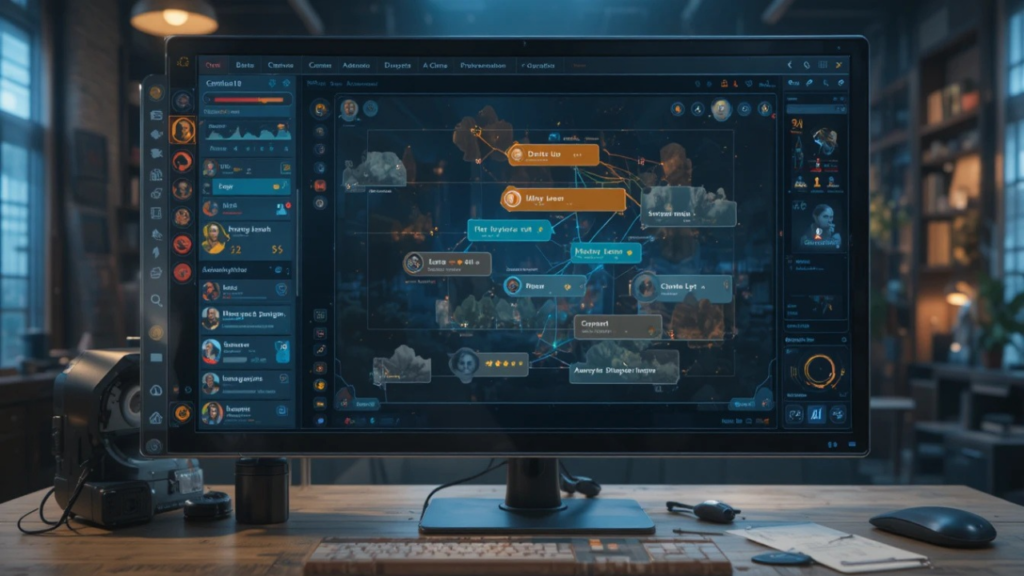
3. ChatMapper — Best AI Story Dialogue Generator for Complex Branching Narratives
ChatMapper has been a staple in the game dialogue world for years, and its integration with AI writing assistance in recent iterations has made it even more powerful. Think of it as the structural backbone for branching narrative — now with AI assistance to fill in the writing.
What Sets It Apart
Where many AI dialogue generators for games focus on real-time NPC responses, ChatMapper is built around designing, mapping, and managing complex conversation trees. The AI writing layer helps writers generate dialogue variations, suggest branches, and fill in placeholder dialogue faster.
It exports to popular formats compatible with Unity (via Dialogue System for Unity) and other engines. For teams managing thousands of dialogue nodes, this organizational muscle is invaluable.
Best for: Narrative designers working on story-heavy games with deep branching, such as visual novels, CRPGs, or adventure games.
Limitations: The AI generation layer is more of an assistant than an autonomous generator — it augments human writers rather than replacing them.
4. AI Dungeon / Latitude API — Best AI Writing Tool for Generative Storytelling
AI Dungeon’s underlying technology, now available through Latitude’s developer API, is one of the most well-known AI story dialogue generators in the gaming space. It’s built on large language models fine-tuned for interactive fiction and generative storytelling.
What Sets It Apart
Latitude’s API gives developers access to a model specifically tuned for creative, open-ended narrative generation. Unlike general-purpose language models, it’s been shaped by millions of interactive fiction interactions — which means it tends to generate more dramatically coherent, contextually relevant dialogue for fantasy, sci-fi, and adventure settings.
It’s also highly flexible. Developers can inject custom world-building context, character descriptions, and tone guidelines directly into the prompt structure.
Best for: Indie developers and experimental games that embrace procedurally generated or emergent storytelling.
Limitations: Output quality can be inconsistent without careful prompt engineering, and content moderation requires active management.
5. Charisma.ai — AI Character Dialogue Generator Built for Narrative Games
Charisma.ai is designed specifically for game developers and storytellers who want AI character dialogue generation without sacrificing narrative control. It sits at the intersection of structured story design and dynamic AI generation.
What Sets It Apart
Charisma uses a visual story editor that lets developers map out story beats, character personalities, and emotional arcs. Within those guardrails, the AI generates dialogue that stays on-brand for each character. This hybrid approach — structured story architecture with generative dialogue — is one of the most practical solutions for studios that need predictability alongside dynamism.
It also supports branching dialogue driven by player choices and game state variables, and comes with a Unity SDK. The tool has been used in educational games, interactive film experiences, and narrative video games.
Best for: Studios that need narrative control alongside AI generation — particularly games with strong storylines where going “off-script” would break the experience.
Limitations: Less suited to fully open-world sandboxes where player interaction is completely freeform.
6. NVIDIA ACE — AI NPC Dialogue Generator with Real-Time GPU-Accelerated Performance
NVIDIA’s Avatar Cloud Engine (ACE) is the heavy hitter on this list — a suite of AI technologies purpose-built for real-time NPC dialogue in AAA-quality games. It combines large language models, speech recognition, facial animation, and audio synthesis into a unified platform.
What Sets It Apart
ACE is designed for the most demanding real-time NPC interaction scenarios. Running on NVIDIA’s GPU infrastructure (or locally on RTX-powered machines), it enables sub-second response latency for spoken NPC conversations. The facial animation layer means NPCs don’t just respond verbally — their expressions and lip sync update dynamically.
NVIDIA has partnered with several game studios to implement ACE in commercial releases, which speaks to its production readiness. The DLSS-powered local inference option is particularly exciting for offline or privacy-sensitive applications.
Best for: AAA studios and well-funded indie teams building games with ambitious NPC interaction and realistic character presentation.
Limitations: Hardware requirements are significant, and the integration complexity is higher than simpler API-based tools.
7. Replica Studios — AI Writing Tool for Game Developers Focused on Voice and Dialogue
Replica Studios rounds out this list as one of the most accessible AI dialogue software platforms for video games, with a particular strength in voice performance. While it started as an AI voice actor platform, it has evolved into a more comprehensive AI dialogue tool for game developers.
What Sets It Apart
Replica’s library of AI voice characters is extensive, and the platform lets you write dialogue, assign it to characters, and generate voice performances — all within one workflow. For small studios and indie developers who can’t afford extensive voice acting sessions, this is a genuine game-changer.
The text-to-speech quality has improved substantially, with options for emotional direction (calm, excited, fearful, etc.) that make NPC voices feel more human. There’s also an API for runtime dialogue generation in games that need dynamic voice output.
Best for: Indie developers and small studios who need both written dialogue and voiced performance without a large voice acting budget.
Limitations: Real-time dynamic dialogue generation for fully open-ended conversations is still maturing on this platform.
How to Choose the Right AI Dialogue Tool for Your Game
With seven strong options on the table, the right choice comes down to a few key questions.
What type of game are you building? An open-world RPG with thousands of NPCs has different needs than a linear narrative game with a cast of ten characters. Tools like Inworld and Convai excel in open, dynamic environments. Tools like ChatMapper and Charisma are better for structured narratives.
What’s your technical setup? If your team is already deep in Unreal Engine 5, NVIDIA ACE and Convai offer strong integrations. Unity developers will find Charisma.ai and Dialogue System for Unity (paired with ChatMapper) to be more natural fits.
What’s your budget? Replica Studios and Latitude’s API offer accessible entry points for smaller teams. Inworld and NVIDIA ACE scale better for larger studios but come with higher costs at scale.
Do you need voice output? Convai, NVIDIA ACE, and Replica Studios all offer integrated voice capabilities. If text-only dialogue is sufficient, the others will serve you well.
Frequently Asked Questions About AI Game Dialogue Tools
What is an AI NPC dialogue generator?
An AI NPC dialogue generator is a software tool that uses artificial intelligence — typically large language models — to create dynamic, contextually appropriate conversation responses for non-player characters in video games. Instead of pre-written static scripts, these tools generate dialogue in real time or assist writers in creating more varied conversation trees faster.
Can AI dialogue tools replace game writers?
Not entirely — and most developers don’t want them to. The best AI conversation tools for game development work alongside human writers, handling repetitive dialogue variations, filler NPC conversations, and dynamic responses while human writers focus on main story beats, character arcs, and key narrative moments. Think of them as a force multiplier, not a replacement.
Are AI game dialogue tools suitable for indie developers?
Absolutely. Several tools on this list — including Replica Studios, Latitude’s API, and Charisma.ai — are priced and designed with smaller teams in mind. The barrier to entry has dropped significantly, meaning indie developers can now create NPC conversations that would have required a large writing team just a few years ago.
How do AI dialogue tools handle offensive or inappropriate content?
Most commercial AI dialogue software for video games includes content moderation layers. Platforms like Inworld and Convai allow developers to set content boundaries, blocking topics or language that fall outside defined parameters. That said, active monitoring is still recommended — especially for games with user-generated dialogue inputs.
Do these tools work offline or do they require internet connectivity?
Most AI NPC conversation generators currently rely on cloud-based inference, meaning an internet connection is required during gameplay. NVIDIA ACE is a notable exception, with local inference available on RTX-equipped machines. This is an evolving area, and local model options are expanding across the industry.
Conclusion: Start Building Smarter NPC Conversations Today
The era of lifeless, repetitive NPC dialogue is ending. AI game dialogue tools have reached a maturity point where they can genuinely transform how players experience the worlds you build — without requiring infinite development resources.
Whether you’re crafting a sprawling open-world RPG that needs thousands of dynamic character interactions, or a tight narrative adventure where every line of dialogue matters, there’s a tool on this list that fits your workflow and budget.
The best place to start? Pick one tool that matches your engine, your team size, and your game type — then run a small prototype. Most of these platforms offer free tiers or trial access, so you can test real NPC conversations before committing.
Your players are waiting for NPCs that actually feel alive. Now you have the tools to make that happen.
Ai NPCs That Remember Players

Founder of Aivexify
Himanshu Deora is an AI tools researcher and digital publisher who tests AI software, automation tools, and emerging technology trends and AI content creator passionate about sharing helpful guides, AI tools, software tutorials, and the latest digital trends. Through Aivexify, he helps readers discover smart technology, productivity tools, and practical online resources in a simple and easy-to-understand way.