
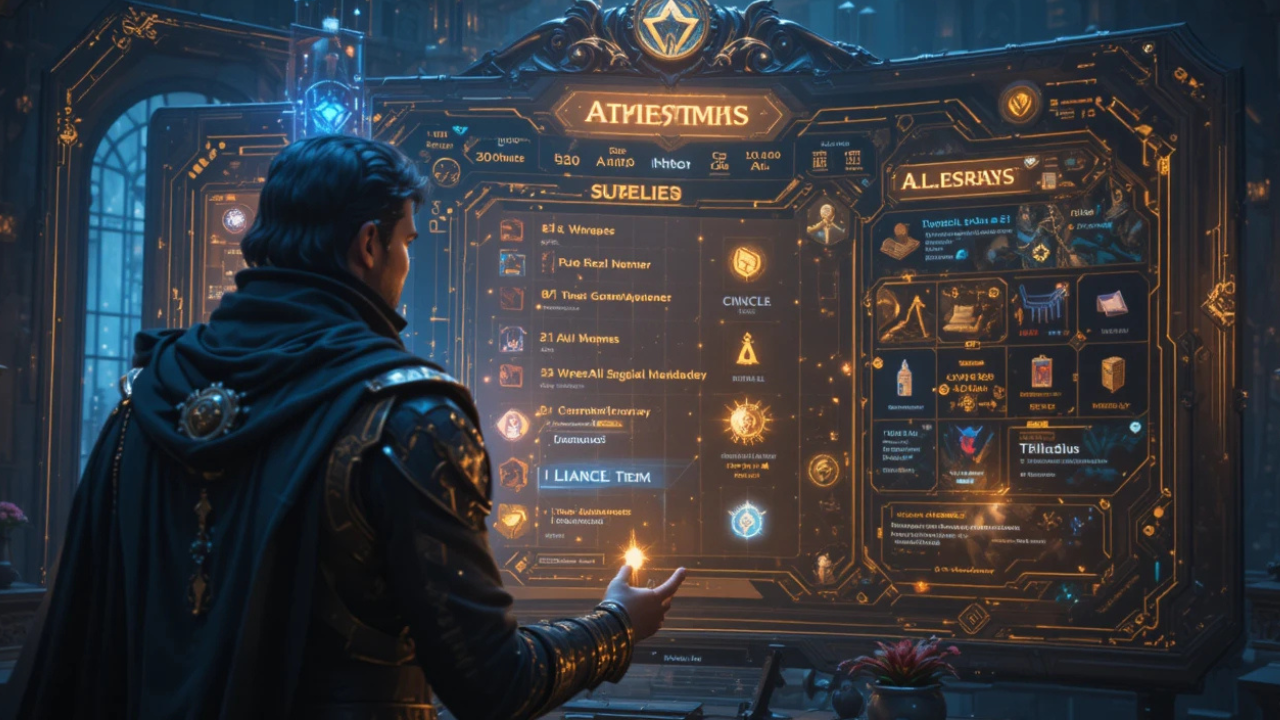
If you’ve ever stared at a blank page trying to invent the perfect quest for your D&D campaign, your indie game’s first dungeon, or your tabletop party’s next adventure — you already know the problem. Coming up with compelling objectives, meaningful NPC motivations, branching consequences, and consistent lore takes serious time and mental energy. That’s exactly where AI quest generators come in.

In 2026, AI-generated quests have moved well past gimmick territory. Dungeon Masters are using them to prep sessions in minutes instead of hours. Indie developers are cutting quest-writing timelines by as much as 87%. Tabletop designers are stress-testing entire campaign arcs before a single dice roll. Whether you need a quick side quest for tonight’s session or a full procedural quest system for your RPG, there’s a tool for it.
This guide breaks down the best AI quest generators and RPG storytelling tools available right now — who they’re for, what makes each one worth using, and how to pick the right one for your specific creative process.
What Is an AI Quest Generator?
An AI quest generator is a tool powered by large language models (LLMs) that creates RPG quest content — objectives, NPC motivations, rewards, plot hooks, dialogue, and branching outcomes — from simple prompts or structured inputs.
At the basic level, you type something like “generate a rescue quest in a haunted forest for level 5 players” and receive a complete quest outline in seconds. More advanced tools let you define your world’s lore, import character sheets, connect quest chains across a campaign, and even adapt quests in real time based on player choices.
The difference between a good AI quest generator and a mediocre one comes down to three things: narrative coherence (does the quest actually make sense?), consistency (does it remember your world?), and control (can you shape and edit the output meaningfully?).
The Best AI Quest Generators in 2026
1. ChatGPT Plus — Best All-Around AI RPG Quest Creator
ChatGPT remains the most widely used AI tool in the game industry. According to a GDC 2026 survey, 74% of game industry professionals who use AI rely on ChatGPT. For quest generation, that popularity is well-deserved.
What it does well: ChatGPT Plus is exceptional at generating quest narratives, branching storylines, character backstories, item descriptions, and dialogue trees. It understands narrative structure, handles complex NPC interactions convincingly, and can maintain consistency within a single session. You can feed it your world’s existing lore and ask it to generate quests that fit your tone, setting, and party level — all in plain language.
Best for: Dungeon Masters who need fast, flexible quest ideas; writers developing RPG scripts; solo players building homebrew worlds.
Limitations: ChatGPT doesn’t have persistent memory across separate sessions by default. If you start a new conversation, it won’t remember the lore or characters from your previous one. You’ll need to paste context back in each time, which gets unwieldy for long campaigns.
Price: Free tier available; ChatGPT Plus at $20/month.
2. Taskade Genesis — Best for Living World Bibles and Connected Quests
Taskade Genesis takes a different approach from most AI quest generators. Rather than just handing you a quest paragraph, it builds and stores quests inside a connected world workspace — alongside your NPCs, lore, factions, and maps.
What it does well: You can generate a side quest, a villain backstory, and a region history in one session, and all three live in the same linked workspace. It uses seven different views (lists, boards, mind maps, timelines, etc.) and comes with 33 built-in AI expansion tools. You can share your world bible with players or collaborators through role-based access and a custom domain — all from a single prompt to start.
Best for: Game Masters running long campaigns who need their quest content integrated with NPCs and lore; worldbuilders who want a living, shareable campaign system.
Limitations: Slightly steeper learning curve than a simple chat interface. Better for organized creators than those who just want a quick one-shot quest.
Price: Free tier available; paid plans for expanded features.
3. AI Realm — Best AI Dungeon Quest Generator for Solo Play
AI Realm functions as a full AI Game Master for D&D-inspired adventures, handling narrative direction, NPC responses, and encounter generation in real time. It takes D&D 5e rules seriously — proper character creation with SRD races, classes, and backgrounds, automated quest tracking, and the ability to swap between eight different AI models mid-campaign.
What it does well: Automated quest tracking is the standout feature. You don’t need a side document to track what happened three sessions ago. The multi-model flexibility is also useful for experienced players who want to fine-tune their experience — choosing a model based on whether they need fast action or nuanced narrative.
Best for: Solo RPG players; Dungeon Masters using it to playtest encounters before sessions; groups who want AI to handle some of the GM workload.
Limitations: The eight-model selection can overwhelm newer users. Version 2 launched with some rough edges, though the core D&D integration is solid.
Price: Free tier available.
4. Sudowrite — Best for Deep Narrative and Long-Form Quest Writing
Sudowrite was built for fiction writers, but its tools translate beautifully to RPG quest design — especially for developers who care about prose quality and narrative depth. Its professional writing features include Describe (five-sense scene generation), Expand/Rewrite, and story structure tools.
What it does well: Where general-purpose AI tends to produce serviceable-but-flat quest text, Sudowrite produces evocative, stylistically consistent writing. If you want your quest descriptions and NPC dialogue to feel like they came from a published sourcebook, this is the tool. It also released the Sudowrite Narrative SDK for game developers who want to integrate narrative generation directly into their own apps.
Best for: Indie developers who want high-quality quest prose; narrative designers building RPGs with literary aspirations; tabletop creators producing premium written content.
Limitations: More expensive than general AI tools; better for writing than for systems design or procedural generation.
Price: From $19/month.
5. NovelAI — Best Free-Budget AI Storytelling Tool for Games
NovelAI is a strong option for game developers who want AI-powered quest writing on a tight budget. Its Lorebook system maintains consistent lore across a project — you define your world’s rules, factions, and characters once, and NovelAI references them when generating new content.
What it does well: Long-form game lore generation, consistency across extended content, and a genuinely generous feature set at lower price points. It’s particularly strong for anime-style settings and works well for generating NPC backstories and flavor text alongside quests.
Best for: Solo indie developers under a budget constraint; creators building anime-adjacent RPGs; anyone who wants a dedicated writing tool without committing to premium pricing.
Price: Plans starting below most competitors.
6. Jenova Roleplay Game Master — Best for Adaptive Campaign Quests
Jenova’s Roleplay Game Master is designed specifically for persistent RPG campaigns where memory matters. Most AI RPG tools operate within limited context windows — once your campaign exceeds that threshold, older quest details, NPC relationships, and past choices get dropped silently. Jenova addresses this directly with unlimited persistent memory across sessions.
What it does well: Every NPC relationship, quest thread, and item in your inventory is preserved. You can switch between AI models (Claude, GPT-5, Gemini, and others) mid-campaign without losing narrative continuity. This makes it particularly powerful for long-running campaigns where earlier quests should have consequences in later ones.
Best for: Players running multi-session campaigns; GMs who need the AI to remember complex plot threads; groups who’ve been frustrated by AI forgetting past events.
Price: Free trial available.
7. StoryRoll — Best AI Quest Generator for Multiplayer Groups
Most AI RPG tools are solo experiences. StoryRoll is the exception. It supports two to four players simultaneously, with the AI serving as a full Game Master — narration, combat, NPCs, dice mechanics, and AI-generated scene art all included.
What it does well: Real-time narration and AI-generated art make the multiplayer experience feel genuinely immersive. The AI handles quest delivery, encounter pacing, and NPC responses without any one player having to “DM.” It’s particularly good for groups who want to play together without anyone taking on the GM burden.
Best for: Friend groups who want AI to run their sessions; online play groups; people who want to introduce new players to RPGs without an experienced DM.
Price: Free to play.
How to Choose the Right AI Quest Generator
With so many options available, the right choice depends on your specific use case:
If you’re a Dungeon Master prepping sessions quickly: ChatGPT Plus or AI Realm give you the fastest, most flexible quest generation with minimal setup.
If you’re an indie game developer building quest systems: Sudowrite (for prose quality), NovelAI (for lore consistency), or the Taskade Genesis API (for connected world management) are your best bets. Budget-conscious solo devs often pair ChatGPT Plus ($20/month) with a lore tracking tool for a cost-effective pipeline.
If you’re running a long campaign: Jenova’s persistent memory system is purpose-built for this. It’s the tool that actually remembers your campaign’s history.
If you’re playing with a group: StoryRoll is the only tool that genuinely supports multiplayer AI-run sessions with real-time narration and dice mechanics.
Tips for Getting the Best Results from AI Quest Generators
The quality of AI-generated quests is only as good as the prompts you give. A few practices that consistently produce better output:
Be specific about context. Instead of “generate a quest,” try “generate a rescue quest for a level 4 party in a coastal town where the harbor master has been kidnapped by smugglers allied with a corrupt local noble.” The more context you provide, the more usable the result.
Define your world’s rules upfront. If magic is rare in your setting, say so. If your tone is dark and morally gray rather than heroic, specify that. AI tools mirror what you tell them.
Use iteration, not regeneration. Don’t just hit “regenerate” if an output isn’t quite right. Ask the tool to refine specific elements: “keep the objective but make the antagonist’s motivation more sympathetic” or “add a branching outcome where the player can negotiate instead of fight.”
Layer quests, don’t just stack them. The most compelling RPG quest design involves quests that connect to each other — a side quest that reveals information relevant to the main story, or an NPC from one quest who reappears in another. Ask your AI tool to create those connections explicitly.
Frequently Asked Questions
Can AI quest generators replace a human Dungeon Master?
Not really — and most tools aren’t trying to. AI quest generators are best thought of as creative assistants that handle the time-consuming mechanical parts of quest design (structure, variation, lore consistency) so human DMs can focus on improv, player relationships, and the moments that make a session memorable. That said, tools like AI Realm and StoryRoll are designed specifically to run sessions autonomously for solo players or leaderless groups.
Are AI-generated quests any good, or do they feel generic?
Quality varies significantly between tools and prompts. Basic one-line prompts tend to produce generic results. Detailed prompts with world context, character motivations, and tone guidance produce content that’s genuinely usable — sometimes excellent. The best AI quest generators in 2026 are capable of producing content that feels purposefully designed, not procedurally generic.
Is it legal to use AI-generated quest content in commercial games?
Generally yes, though the specifics depend on the tool’s terms of service and your jurisdiction. Most tools, including Sudowrite, explicitly state users own the output. However, raw AI-generated content with no human creative input is generally not copyright-protected in the US — you’ll want to edit and shape the output meaningfully if copyright protection matters to your project. When in doubt, consult a legal professional familiar with AI content.
How much do AI quest generators cost?
The range is wide. Free tiers are available from ChatGPT, AI Realm, StoryRoll, and others. Paid plans start around $16–$20/month for tools like ChatGPT Plus and Sudowrite. According to industry estimates, a solo indie developer can cover most AI content needs — quest writing included — for $50–70/month using a combination of tools.
Do AI quest generators work for non-D&D systems?
Yes. General-purpose tools like ChatGPT Plus work for any RPG system because you define the rules in your prompt. System-specific tools like AI Realm focus on D&D 5e but can often adapt to similar systems. For fully system-agnostic generation, ChatGPT Plus and Jenova are the most flexible.
Conclusion
AI quest generators in 2026 are genuinely useful tools — not replacements for creativity, but multipliers of it. The right tool depends on whether you’re a solo GM prepping for Friday night, an indie developer building a quest-heavy RPG, or a group of players looking for AI to run your campaign. Each use case has a purpose-built solution now.
Start with what’s free. ChatGPT’s free tier and AI Realm’s free access both give you meaningful quest generation without commitment. Once you know what you need — deeper lore integration, better prose, persistent memory, or multiplayer support — you’ll have a clear sense of which paid tool is worth the upgrade.
The blank page problem for quest design is largely solved. The question now is how creatively you use these tools to build something genuinely memorable.
Explore more on RPG game design: [Internal link opportunity: AI worldbuilding tools roundup] | [Internal link opportunity: How to build your first indie RPG] | [Internal link opportunity: Prompt engineering for creative writing]
Ai Customer Support Automation

Founder of Aivexify
Himanshu Deora is an AI tools researcher and digital publisher who tests AI software, automation tools, and emerging technology trends and AI content creator passionate about sharing helpful guides, AI tools, software tutorials, and the latest digital trends. Through Aivexify, he helps readers discover smart technology, productivity tools, and practical online resources in a simple and easy-to-understand way.