
Imagine a coach who never sleeps, never misses a game, and can process millions of data points in seconds. That’s not science fiction — that’s what AI sports analytics looks like in 2026.
From the Premier League to the NBA, from college football fields to Olympic training centers, artificial intelligence is quietly — and sometimes loudly — rewriting the rules of how teams prepare, compete, and recover. The global sports analytics market is expected to surpass $10 billion by 2027, and the teams embracing AI today are building the competitive advantages that will define the next decade.

But what exactly is AI sports analytics? How does it work in practice? And is it only for elite professional clubs with massive budgets?
In this guide, we’ll break down everything you need to know about AI for sports analytics — from how machine learning tracks athlete performance to how predictive analytics is preventing injuries before they happen. Whether you’re a coach, a sports professional, or just a curious fan, this is your complete look at one of the most exciting developments in modern sport.
What Is AI Sports Analytics? A Plain-English Explanation
AI sports analytics is the use of artificial intelligence — including machine learning, computer vision, and data science — to collect, process, and interpret performance data in sports. It goes far beyond traditional statistics.
Where old-school stats told you what happened (a player scored 20 points), AI sports analytics tells you why it happened, how it’s likely to happen again, and what you can do about it.
The Core Technologies Behind AI Sports Data Analysis
Several technologies work together to make modern sports analytics possible:
- Machine learning algorithms — software that learns patterns from data and improves over time without being explicitly programmed
- Computer vision — AI that analyzes video footage to track player movements, positioning, and biomechanics in real time
- Wearable sensors — GPS trackers, heart rate monitors, and accelerometers that feed live data to analytics platforms
- Natural language processing (NLP) — AI that reads scouting reports, injury logs, and even social media to build richer player profiles
- Predictive modeling — statistical models that forecast future outcomes based on historical patterns
| Quick Answer: AI sports analytics combines machine learning, computer vision, and sensor data to give coaches and teams real-time, actionable insights about player performance, fitness, tactics, and risk — insights that were impossible to generate manually. |
AI Athlete Performance Tracking: From Guesswork to Precision
One of the most immediate applications of AI in sports is tracking how athletes perform — not just in games, but in training, recovery, and even sleep.
Traditional performance tracking meant watching film for hours and relying on a coach’s intuition. AI athlete performance tracking changes that completely. Every sprint, every jump, every change of direction can now be captured, quantified, and compared.
What AI Can Now Track in Real Time
- Sprint speed, acceleration, and deceleration across every training session
- Muscle load and fatigue levels using wearable sensors on the body
- Movement efficiency — whether an athlete is running, throwing, or jumping with optimal technique
- Heart rate variability (HRV), which serves as a reliable indicator of recovery and readiness
- Sleep quality and how it correlates with next-day performance output
Teams like Manchester City, the Golden State Warriors, and the All Blacks rugby team have used AI-powered performance tracking to gain a measurable edge. The result? Smarter training loads, fewer burnout cases, and athletes who peak at exactly the right moments.
AI sports performance software like Catapult, STATSports, and Zebra Technologies are now standard kit in elite sports environments. These platforms ingest raw sensor data and turn it into dashboards coaches can actually act on — not spreadsheets that gather dust.
AI Sports Injury Prevention: Catching Problems Before They Start
Ask any professional coach what keeps them up at night, and injuries will be near the top of the list. A single serious injury can derail a season, cost millions in lost performance and medical bills, and sometimes end a career.
This is where AI in sports injury prevention has become genuinely game-changing.
How Predictive Analytics Flags Injury Risk
AI systems can now detect the early warning signs of injury that the human eye simply cannot see. By monitoring subtle changes in movement patterns, force output, and recovery metrics over time, machine learning models build a personalized baseline for each athlete.
When something deviates from that baseline — even slightly — the system raises an alert. A hamstring strain that would have happened in three weeks can be prevented by adjusting an athlete’s training load today.
| Real-World Example: Liverpool FC implemented AI-powered injury prevention tools and reportedly saw a significant reduction in soft tissue injuries over subsequent seasons — a finding consistent with published research on predictive load management in elite soccer. |
The key metrics that AI monitors for injury risk include:
- Asymmetry in movement — when one side of the body is doing significantly more work than the other
- Cumulative training load — tracking whether athletes are being pushed too hard over time
- Recovery scores — how well the body has bounced back from previous sessions
- Sleep and nutrition data — lifestyle factors that influence injury susceptibility
- Historical injury patterns — using past data to identify which athletes are statistically most at risk
Predictive Analytics in Sports: Game Strategy Gets Smarter
Beyond individual athlete performance, AI is changing how teams prepare for opponents. Predictive analytics in sports means teams can now model what their competitors are likely to do before a game even starts.
Tactical Analysis and Game Planning with AI
AI coaching tools process thousands of hours of opponent footage to identify patterns — the plays they run most often in third-and-short situations, the defensive formations a goalkeeper defaults to under pressure, the tendencies a point guard shows when guarded on the left.
For AI football analytics specifically, the NFL, Premier League clubs, and college programs have invested heavily in AI systems that generate opponent tendency reports far more detailed and faster than any human scout could produce manually.
This kind of AI sports data analysis means coaching staff can walk into a game with a data-backed game plan, not just instinct. It doesn’t replace the coach’s judgment — it informs it.
In-Game Decision Support
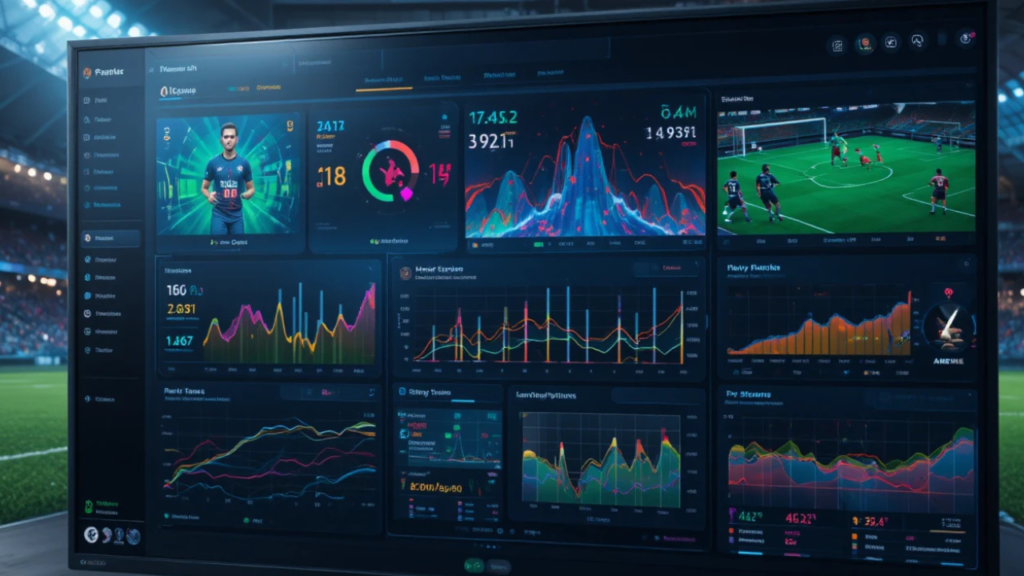
Some teams are even beginning to use AI-powered sports insights during games. Real-time dashboards can flag when a pitcher’s velocity is dropping (a sign of fatigue), when a basketball team’s defensive rotations are breaking down, or when the right moment has arrived to sub in a fresh player.
Formula 1 teams have been using real-time AI data analysis for years — modeling tire wear, fuel consumption, and weather changes to make pit stop decisions that can mean the difference between winning and losing a race.
AI Sports Performance Software: What Are Teams Actually Using?
The AI sports analytics ecosystem has matured rapidly. Here’s a look at the categories of tools teams are deploying today:
Wearable Performance Tracking
- Catapult Sports — GPS vests and inertial sensors used by hundreds of elite clubs worldwide
- STATSports — wearable tracking popular in soccer, GAA, and rugby
- Polar Team Pro — heart rate and GPS tracking with cloud analytics
Video and Computer Vision Platforms
- Hudl — widely used for video analysis and play diagramming from youth to professional level
- StatsBomb — detailed event data and 360-degree tracking for soccer
- Second Spectrum — used by NBA teams for real-time optical tracking and insight generation
AI Coaching Tools and Decision Platforms
- Genius Sports — real-time data powering decisions in NFL and NCAA
- Sport Logic AI — tactical analysis platforms for team sports
- Kitman Labs — athlete intelligence platform combining health, performance, and readiness data
What’s striking is that many of these tools are no longer exclusively for elite clubs. Pricing and accessibility have improved dramatically, meaning lower-division teams, college programs, and even serious amateur clubs now have access to AI for team performance that was previously reserved for the world’s richest sports organizations.
Machine Learning in Sports Analytics: The Technology Getting Smarter Every Season
One of the unique advantages of machine learning in sports analytics is that the systems get better with more data. Every season of games, every training session logged, every recovery score entered — it all feeds the model and sharpens its predictions.
This creates a compounding advantage for organizations that start early. Teams using AI-powered systems today are building proprietary datasets and trained models that will be significantly more powerful in three to five years than anything a late adopter can purchase off the shelf.
Deep Learning and Computer Vision Advances
Recent advances in deep learning have made computer vision in sports dramatically more accurate. Modern AI systems can now track 22 players simultaneously in a soccer match, identify individual athletes without jersey recognition, and map the three-dimensional positions of every body part throughout a movement.
This means biomechanical analysis that used to require motion-capture suits in a lab can now be done from regular broadcast footage — at scale, in real time, at a fraction of the previous cost.
The Human Side of AI in Professional Sports
With all this technology, a reasonable question arises: does AI in professional sports risk removing the human element from the game?
The short answer from coaches and athletes who use these tools is: no. In fact, most practitioners describe AI as a way to have better conversations, not to replace human judgment.
A coach who used to say ‘I think you’re doing too much this week’ can now say ‘Your HRV has dropped 18% over three days and your asymmetry score is outside your normal range — let’s ease up.’ That’s a more compelling conversation, and it’s more likely to result in the athlete actually listening.
The best AI coaching tools are designed to surface insights and flag concerns, leaving decisions in the hands of coaches, medical staff, and athletes. The technology augments expertise; it doesn’t replace it.
That said, legitimate concerns around data privacy, athlete consent, and the potential over-reliance on algorithmic decision-making are part of ongoing conversations in sports governance. Organizations like FIFPRO (the world soccer players’ union) have pushed for clearer frameworks around how player data is collected, used, and owned.
Frequently Asked Questions About AI Sports Analytics
What is AI sports analytics, and how is it different from traditional sports statistics?
Traditional sports statistics capture what happened in a game — goals scored, yards gained, batting average. AI sports analytics goes further by using machine learning to identify patterns, make predictions, and generate recommendations. It’s the difference between a scoreboard and a complete performance intelligence system.
Is AI athlete performance tracking only for professional sports teams?
No. While elite clubs were early adopters, the cost of AI sports performance software has fallen significantly. Many platforms now offer solutions suitable for college programs, academies, and serious amateur clubs. Wearable devices and video analysis tools that cost tens of thousands of dollars five years ago are now available at accessible price points.
How does AI help prevent sports injuries?
AI sports injury prevention works by building a performance baseline for each individual athlete and monitoring for deviations. By tracking metrics like movement asymmetry, training load, and recovery scores over time, machine learning models can identify risk patterns before an injury occurs — often days or weeks in advance. Coaches can then adjust training plans to reduce that risk.
Can AI replace coaches and scouts in sports?
No, and most experts don’t believe it will. AI coaching tools are designed to inform and enhance human decision-making, not replace it. Coaching involves relationships, motivation, in-game intuition, and leadership — qualities that AI cannot replicate. What AI does is give coaches better information, faster, so their decisions are more likely to be right.
Which sports are leading the adoption of AI analytics?
Soccer (football), basketball, American football, baseball, cricket, tennis, and Formula 1 are among the most advanced adopters. Baseball has a long tradition of data analytics (the ‘Moneyball’ era), while soccer and basketball have seen the most rapid recent growth in AI-powered tools. Individual sports like tennis and athletics are also increasingly using AI for biomechanics and performance optimization.
Conclusion: The Future of Sport Is Already Here
AI sports analytics is not a coming revolution — it’s a present reality. The teams, athletes, and organizations that are winning with data today are not using magic; they’re using tools that are increasingly available to anyone willing to invest in them.
From AI athlete performance tracking that catches fatigue before it becomes injury, to predictive analytics in sports that maps what your opponents will do before kickoff, the applications of artificial intelligence in sport are broad, practical, and growing fast.
The question is no longer whether AI will transform sports performance. It already has. The question is whether your team, your organization, or your coaching staff will be part of that transformation — or watching it from the sidelines.
Related article:
Can AI predict the world cup winner

Founder of Aivexify
Himanshu Deora is an AI tools researcher and digital publisher who tests AI software, automation tools, and emerging technology trends and AI content creator passionate about sharing helpful guides, AI tools, software tutorials, and the latest digital trends. Through Aivexify, he helps readers discover smart technology, productivity tools, and practical online resources in a simple and easy-to-understand way.