

The FIFA World Cup is the single biggest sporting event on the planet. Every four years, billions of fans tune in, argue over group stages, and debate who will lift the trophy. And now, thanks to rapid advances in machine learning and sports analytics, you no longer have to rely purely on gut feeling. An AI World Cup simulator can crunch thousands of data points — team form, player stats, historical head-to-head records, tactical setups — and give you a data-driven prediction before a ball is even kicked.
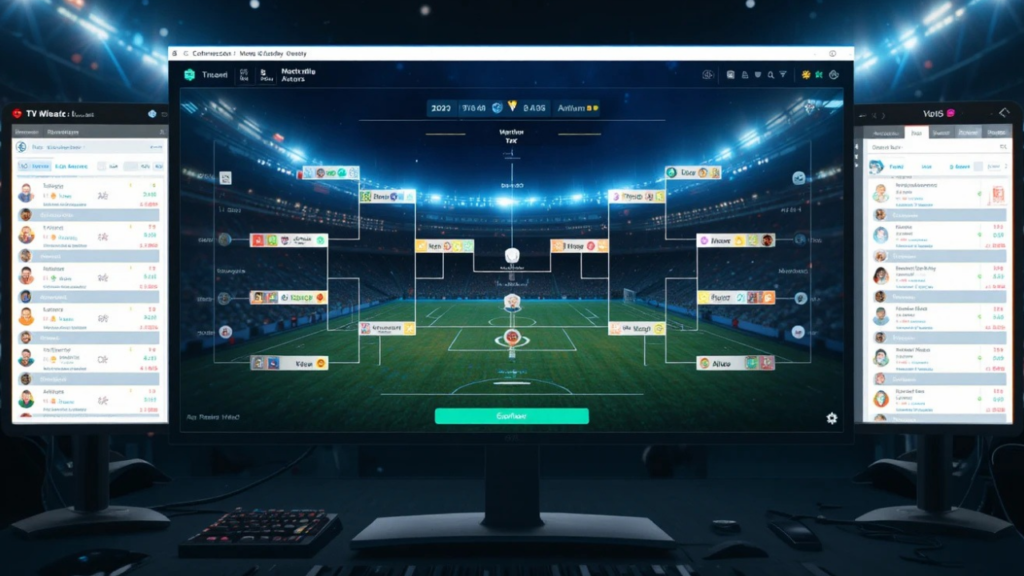
With the 2026 FIFA World Cup just around the corner (hosted across the United States, Canada, and Mexico), interest in AI football prediction tools has never been higher. Whether you’re running an office sweepstake, writing a football blog, or just deeply invested in your national team’s chances, this guide will walk you through everything you need to know about AI World Cup prediction: how it works, what the best tools offer, and how to get the most out of them.
What Is an AI World Cup Simulator?
An AI World Cup simulator is a software tool — often web-based — that uses artificial intelligence and statistical modeling to predict the outcomes of FIFA World Cup matches and tournaments. Rather than a single random draw, these simulators run thousands (sometimes millions) of simulated matches using real-world data.
The output is usually expressed as probability percentages: “Brazil has a 34% chance of winning the tournament,” or “England vs. France ends with England winning 55% of simulated match-ups.” Some tools let you adjust variables yourself — swapping out injured players, changing formations, or stress-testing specific bracket scenarios.
At its core, an AI football match simulator does three things:
- Collects data — historical results, current form, FIFA rankings, player performance metrics, injury reports
- Builds a model — typically using machine learning algorithms trained on decades of football data
- Runs simulations — repeating match outcomes thousands of times and averaging the results into probability scores
The result is far more nuanced than a simple prediction. It gives you a probability landscape: who is most likely to win, but also who is the dark horse, and which group stage matchup could flip the entire bracket.
How AI Football Analytics Actually Work
You might wonder what separates a proper AI football simulator from a random number generator dressed up in a football kit. The answer is in the data and the model quality.
The Data Behind the Predictions
Good AI World Cup prediction models ingest a wide range of inputs:
- Team-level data: FIFA world rankings, recent form (last 10–20 matches), home/away performance splits, goals scored and conceded
- Player-level data: Key player availability, top scorer form, defensive stability metrics (expected goals against, clean sheet rates)
- Historical head-to-head records: Some matchups carry decades of psychological weight — think Germany vs. England or Brazil vs. Argentina — and models factor in these patterns
- Tactical and stylistic factors: Pressing intensity, possession style, set-piece efficiency
- Tournament-specific context: Group difficulty, travel distances in expanded tournaments, rest days between matches
The Models Powering AI Match Outcome Predictions
Most serious AI football analytics platforms use one or more of these approaches:
Poisson regression is a statistical workhorse for football prediction. It models how many goals each team is expected to score based on their attacking and defensive strength, then calculates the probability of every scoreline.
Elo rating systems (originally developed for chess) assign each team a rating that updates after every match. Teams with higher Elo scores are favored, and the model predicts win probability accordingly.
Machine learning models — particularly gradient boosting methods like XGBoost, or neural networks — can find non-linear relationships across hundreds of variables that simpler models miss. These are increasingly common in the most sophisticated FIFA World Cup prediction models.
Monte Carlo simulation ties everything together. Instead of calculating one outcome, the simulator runs 10,000 or 100,000 virtual tournaments, recording results each time. The final output is a frequency distribution — the percentage of simulations in which each team wins.
What Can You Do With an AI World Cup Bracket Predictor?
The practical uses of an AI World Cup bracket predictor go well beyond satisfying curiosity. Here are some of the most popular use cases:
Simulate the Entire Tournament
Most tools let you run a full 2026 World Cup simulation from group stage to final. You get predicted group standings, knockout round matchups, and an estimated champion — all in seconds. Run it again, and the result shifts slightly, reflecting the genuine uncertainty baked into any football tournament.
Explore “What If” Scenarios
What if Mbappé picks up an injury in the group stage? What if the United States gets a favorable draw? AI football simulators let you tweak inputs and see how sensitive the tournament outcome is to individual changes. This is where these tools get genuinely fascinating for football analysts and fans alike.
Compare Multiple AI Predictions
No single model is perfect. Smart users compare outputs from several AI sports prediction tools and look for consensus. If four different simulators give Brazil a 25–30% win probability and one outlier model says 10%, that tells you something about model assumptions rather than Brazil’s actual chances.
Power Your Fantasy Football or Sweepstake Strategy
With 48 teams in the 2026 World Cup, picking a sweepstake winner or a fantasy football squad without data is a lottery. An AI World Cup forecast gives you an informed edge — you can identify which mid-ranked team has an unusually kind group draw, for example, or which goalkeeper has the best save percentage in tournament conditions.
The Best AI World Cup Prediction Tools in 2026
The landscape of World Cup prediction software has grown significantly. Here’s what to look for and some categories of tools worth exploring:
Dedicated AI Tournament Simulators
Some platforms are built specifically for tournament prediction. They offer clean interfaces where you input the 48 qualified teams, and the AI runs the bracket for you. The best ones update in real time as actual group stage results come in, recalculating knockout probabilities on the fly.
Look for tools that show you confidence intervals alongside predictions. A tool that just says “Spain wins” is less useful than one that says “Spain wins 22% of simulations, with a range suggesting they reach the semi-finals in over 60% of cases.”
Sports Analytics Platforms with AI Modules
Established sports analytics companies — including several that supply data directly to professional clubs — have begun offering public-facing AI match outcome prediction tools around major tournaments. These typically have the richest underlying data but may require a subscription.
Academic and Open-Source Models
Several universities and research groups publish open-source FIFA World Cup prediction models before each tournament. These are transparent — you can inspect the methodology — and often generate significant media coverage when their pre-tournament predictions turn out to be accurate (or amusingly wrong). The 2018 and 2022 tournaments saw a flurry of such models.
Betting Market-Integrated Tools
Betting odds markets aggregate the wisdom of thousands of professional traders and are often treated as a form of collective AI prediction in their own right. Some AI football simulator tools incorporate live market odds as one of their input signals, blending statistical models with market consensus.
How Accurate Are AI World Cup Predictions?
Honest answer: no model predicts football perfectly, and any tool that claims otherwise is selling something. Football is a low-scoring, high-variance sport. A single goal off a deflected free-kick can eliminate a statistically superior team.
That said, AI football analytics do meaningfully outperform random chance and naive prediction methods. Research consistently shows that:
- Group stage outcomes are moderately predictable — the top-ranked team progresses in roughly 70–75% of cases when they face a significantly weaker opponent
- Knockout rounds are far more volatile — the underdog wins around 30–35% of single-elimination matches at World Cup level, much higher than in league football where form averages out over many games
- Tournament winners are very hard to call — the true favorite (by most AI models) wins only about 25–35% of the time across simulated outcomes, which means upsets are not the exception but a structural feature of the format
The most valuable thing an AI World Cup forecast gives you is not certainty — it’s a calibrated probability map. You know who is genuinely dangerous, who is overrated by public sentiment, and where the real uncertainty lies.
Tips for Getting the Most Out of AI Soccer Prediction Tools
Using these tools well is a skill in itself. Here are some practical pointers:
Run simulations multiple times. Each run will produce slightly different results due to the random elements baked in. Run 5–10 simulations and look at the range of outcomes rather than fixating on one result.
Update after each matchday. The best AI World Cup simulators update their probabilities as real results come in. A team that scrapes through the group stage on goal difference starts the knockouts very differently than one that won all three group games.
Cross-reference with injury news. AI models can only work with the data they’re given. If a key player picks up an injury the morning of a match that hasn’t been fed into the system yet, your prediction is stale. Always sanity-check outputs against the latest team news.
Use predictions as a conversation starter, not a verdict. The best use of an AI football match simulator is to generate informed questions — why does this model rate Portugal so highly? What assumptions drive Spain’s relatively low win probability? — rather than to replace your own football judgment.
FAQ: AI World Cup Simulator
Q: Can an AI actually predict who will win the 2026 FIFA World Cup?
Not with certainty. AI World Cup prediction models generate probability estimates across thousands of simulated tournaments. They can identify the most likely winner, but no model can account for all the randomness in a real football tournament. The best models express their output as probabilities, not guarantees.
Q: What data do AI football simulators use?
Most AI football analytics platforms draw on FIFA world rankings, historical match results, recent team form (last 10–20 games), player availability and injury status, and sometimes betting market odds. More sophisticated models also incorporate expected goals (xG) data, tactical metrics, and tournament-specific performance history.
Q: Are AI World Cup prediction tools free to use?
Many are free or have free tiers, particularly those built for media engagement around major tournaments. More data-rich platforms — especially those used by professional clubs or serious bettors — typically require subscriptions. Open-source academic models are freely available but may require some technical knowledge to run.
Q: How is an AI World Cup simulator different from a regular football prediction site?
Traditional prediction sites often rely on expert opinion, betting odds, or simple ranking-based formulas. An AI tournament simulator uses machine learning models trained on large datasets and runs Monte Carlo simulations to generate probability distributions across all possible outcomes — a fundamentally more rigorous approach.
Q: Which team do AI models favor to win the 2026 FIFA World Cup?
As of mid-2026, most AI football prediction models consistently highlight France, Brazil, England, and Spain among the top contenders — with win probabilities typically ranging from 12–22% for the frontrunner. The host nations (USA, Canada, Mexico) benefit from home advantage effects, which some models factor in explicitly. Always check current model outputs as squad fitness and form evolve.

Conclusion: Make the 2026 World Cup More Interesting With AI
The 2026 FIFA World Cup — the largest in history with 48 teams — offers more uncertainty, more upsets, and more drama than any previous edition. That makes AI World Cup prediction tools more relevant and more entertaining than ever.
Whether you want to run a full AI World Cup bracket predictor before the tournament starts, simulate specific matchups to settle debates with friends, or use AI football analytics to build a sharper understanding of team strengths and vulnerabilities, the tools available today are genuinely impressive — and becoming more accurate with each tournament cycle.
The best approach is to treat them as what they are: powerful, data-driven thinking aids. They won’t tell you the future. But they’ll help you think about it much more clearly.
Ready to explore AI World Cup simulators for 2026? Search for dedicated football AI prediction platforms, compare a few different models, and start running your brackets. You might be surprised how quickly the numbers change your intuitions about who’s really a contender — and who’s just riding the hype.
Ai Workflow Templates

Founder of Aivexify
Himanshu Deora is an AI tools researcher and digital publisher who tests AI software, automation tools, and emerging technology trends and AI content creator passionate about sharing helpful guides, AI tools, software tutorials, and the latest digital trends. Through Aivexify, he helps readers discover smart technology, productivity tools, and practical online resources in a simple and easy-to-understand way.