

Football has always been a game of instinct, grit, and split-second decisions. But walk into any top-flight club’s analysis room today, and you’ll find something that would have seemed like science fiction a decade ago: rows of screens tracking every player’s movement, heart rate, and decision pattern in real time. This is the new reality of AI in football — and it’s changing how the sport is played, coached, and watched.
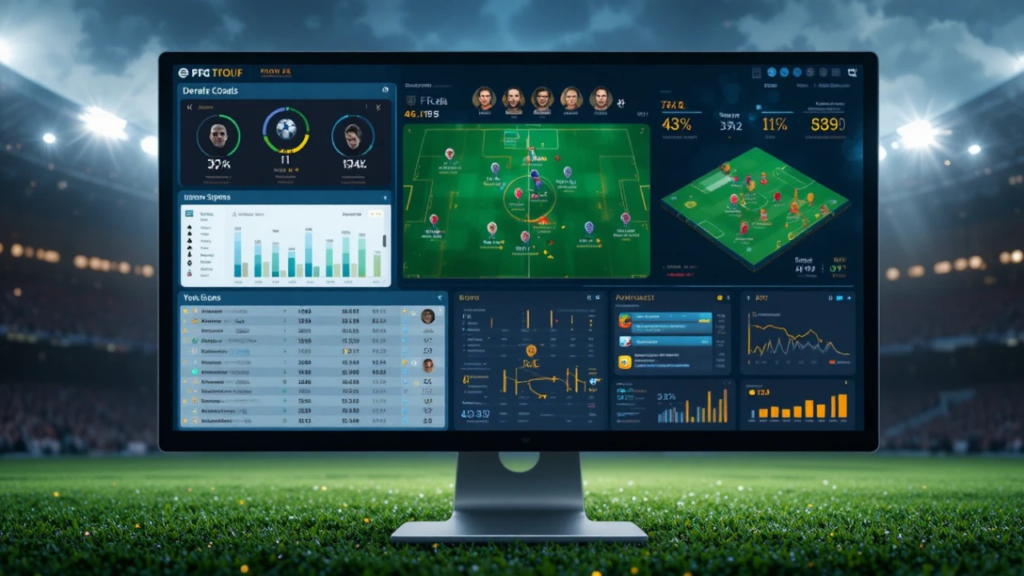
Whether you’re a coach trying to squeeze more out of your squad, a scout hunting for the next breakout talent, or just a fan curious about why pundits keep mentioning “expected goals” and “AI-driven insights,” this guide breaks down everything you need to know. We’ll cover how artificial intelligence in football works in practice, where it’s making the biggest impact, and what the future holds as we move further into 2026.
What Is AI in Football, Exactly?
At its core, AI in football refers to the use of machine learning, computer vision, and predictive algorithms to analyze data generated during training sessions and matches. Instead of relying solely on a coach’s eye or a stats sheet from a match report, clubs now feed enormous volumes of data — player GPS tracking, ball trajectory, biometric readings, even crowd noise — into systems that can spot patterns no human could catch in real time.
This isn’t a single tool. It’s an ecosystem. AI football technology spans several categories:
- Computer vision systems that track every player and the ball, frame by frame
- Predictive models that forecast outcomes like injury risk or match results
- Natural language processing tools that generate instant match reports
- Recommendation engines that suggest transfer targets based on playing style compatibility
Clubs like Manchester City and Liverpool have publicly discussed using data science teams to support recruitment and tactical planning, while smaller clubs are increasingly adopting affordable AI platforms to level the playing field against bigger budgets.
AI Football Analytics: Turning Raw Data Into Game-Winning Insight
How AI Football Analysis Works Behind the Scenes
AI in football analytics starts with data collection. Modern stadiums and training grounds are wired with optical tracking cameras and wearable sensors that capture up to 25 data points per second for every player on the pitch. That’s millions of data points per match.
Once collected, this raw data is virtually useless without analysis. That’s where machine learning models step in. They identify patterns like:
- Which passing lanes a team consistently exploits
- How a player’s sprint speed degrades over 90 minutes
- Which defensive shapes are most vulnerable to counterattacks
The result is football data analytics with AI that gives coaching staff a clearer, evidence-based picture instead of relying purely on gut feeling after watching match footage.
Why This Matters for Everyday Fans, Not Just Clubs
You don’t need to work for a Premier League club to benefit from this shift. Broadcasters now use AI-generated stats like expected goals (xG) and pass completion probability to enrich match commentary, helping casual fans understand why a missed chance was actually a high-quality opportunity, or why a manager made a tactical substitution.
AI Football Coaching: A New Assistant on the Touchline
Personalized Training Plans
AI football coaching tools are increasingly used to design individualized training regimens. Instead of a one-size-fits-all session, AI can analyze a player’s recent workload, recovery metrics, and performance trends to recommend specific drills — more sprint work for a winger showing reduced top-speed output, or recovery-focused sessions for a midfielder carrying a heavy minutes load.
This data-driven approach helps reduce burnout and supports longer, healthier careers, particularly for younger academy players still developing physically.
Real-Time Tactical Feedback
Some clubs are experimenting with AI systems that provide near real-time tactical suggestions during matches, flagging when an opponent’s defensive line is overcommitting or when a specific formation shift is creating space out wide. While human coaches still make the final call, these insights act as a second set of eyes that never gets tired or distracted.
AI Football Tactics: Rethinking Strategy With Data
AI football tactics go beyond simple stat-tracking. Modern systems can simulate thousands of in-game scenarios to predict the statistical likelihood of success for different tactical approaches before a ball is even kicked.
For example, a club preparing to face a high-pressing opponent might use AI simulations to test how different build-up patterns hold up against that pressure, adjusting training focus accordingly in the days leading up to the match. This kind of preparation was previously limited to whatever scouting footage a coaching staff could manually review — now it’s backed by probability models drawn from thousands of similar in-game situations across leagues.
AI Player Performance Analysis: Measuring What the Eye Can Miss
Tracking Physical and Technical Development
AI player performance analysis tools measure far more than goals and assists. They assess deceleration patterns that might indicate injury risk, decision-making speed under pressure, and even how a player’s performance shifts based on fatigue or match context.
This granular insight helps clubs make smarter decisions about squad rotation, contract renewals, and rehabilitation timelines after injury.
Injury Prevention Through Predictive Modeling
One of the most valuable applications of AI in elite football is predictive injury modeling. By analyzing historical injury data alongside current workload and biomechanical patterns, AI systems can flag players at elevated risk before an injury occurs, giving medical staff a window to intervene with adjusted training loads or extra recovery time.
AI Football Scouting: Finding Talent Beyond the Obvious
Traditional scouting relied heavily on watching players in person or reviewing limited match footage. AI football scouting has expanded that net dramatically. Algorithms can now scan performance data from thousands of players across lower-profile leagues worldwide, flagging individuals whose statistical profile matches a club’s tactical needs — even if no human scout has ever seen them play live.
This has proven especially valuable for smaller clubs without the scouting budgets of major European sides, helping them identify undervalued talent in markets that were previously overlooked. It also reduces some of the human bias that can creep into traditional scouting, where reputation or league prestige sometimes outweighs actual on-pitch output.
AI in Soccer Analytics: A Global Perspective
While “football” and “soccer” describe the same sport in different parts of the world, the application of AI in soccer analytics is just as widespread in North America. Major League Soccer clubs and youth development academies in the United States have increasingly adopted data platforms similar to those used in Europe, reflecting a broader, global standardization of how the sport approaches performance analysis.
This convergence means insights and tools developed for one league often transfer effectively to another, accelerating innovation across the sport as a whole.
AI-Powered Football Predictions: Hype or Genuinely Useful?
AI-powered football predictions have become a fixture in sports media, from match outcome forecasts to player performance projections. These models typically draw on historical results, current form, head-to-head records, and even weather conditions to generate probability-based forecasts.
It’s worth noting these predictions are probabilistic, not guarantees — football’s unpredictability is part of its appeal, and no algorithm fully accounts for moments of individual brilliance or sheer luck. That said, prediction models have become noticeably more accurate over recent years as data quality and computing power have improved, making them a genuinely useful reference point for fans, fantasy football players, and analysts alike.
Challenges and Limitations of AI in Football
It’s not all smooth sailing. A few honest challenges remain:
- Data privacy concerns: Biometric and health data raise legitimate questions about player consent and data ownership.
- Over-reliance risk: Some critics argue that leaning too heavily on AI insights could erode the intuitive, instinctive decision-making that makes football exciting.
- Cost barriers: While prices are coming down, top-tier AI analytics platforms remain out of reach for many lower-league and amateur clubs.
- Human interpretation still matters: Data can tell you what happened, but understanding why — locker room dynamics, player morale, leadership — still requires human judgment.
These limitations don’t undermine the value of AI in football, but they’re worth keeping in mind as the technology continues to mature.
Frequently Asked Questions
Is AI replacing football coaches? No. AI serves as a support tool that enhances decision-making with data-driven insights, but tactical judgment, man-management, and motivation remain firmly human responsibilities.
How accurate are AI football predictions? Modern prediction models have improved significantly thanks to better data and computing power, but football’s inherent unpredictability means no model offers guaranteed accuracy. They’re best used as an informed reference point rather than a certainty.
Do smaller clubs use AI, or is it only for big teams like Real Madrid and Manchester United? Adoption has spread well beyond elite clubs. Affordable analytics platforms have made AI football scouting and performance tracking accessible to clubs at nearly every level, including academies and lower-division sides.
What kind of data does AI football analytics actually use? It typically combines GPS tracking, optical camera data, biometric sensors (heart rate, sleep, recovery), and historical match statistics to build a comprehensive performance picture.
Will AI change how fans watch football? It already has. Broadcast graphics like expected goals (xG), pass probability, and AI-generated highlight reels are now standard in many televised matches, giving fans richer context in real time.

The Final Whistle: Where AI in Football Goes From Here
AI in football isn’t a passing trend — it’s becoming woven into how the sport is played, coached, scouted, and watched. From personalized training plans to predictive injury prevention and smarter scouting, artificial intelligence is helping clubs and players unlock margins that simply weren’t visible before. At the same time, the heart of football — passion, instinct, and unpredictability — remains untouched by algorithms, and that balance is exactly what makes this moment in the sport’s evolution so interesting.
If you’re a club, coach, or analyst looking to explore how AI football analytics could sharpen your own approach to performance, scouting, or match preparation, now is the time to start experimenting. The tools are more accessible than ever, and the clubs embracing them today are setting themselves up to compete smarter tomorrow.
Curious how AI-driven insights could apply to your own team or analysis workflow? Reach out to discuss the right tools and strategy for your goals.
Related Article:
AI world cup Simulator

Founder of Aivexify
Himanshu Deora is an AI tools researcher and digital publisher who tests AI software, automation tools, and emerging technology trends and AI content creator passionate about sharing helpful guides, AI tools, software tutorials, and the latest digital trends. Through Aivexify, he helps readers discover smart technology, productivity tools, and practical online resources in a simple and easy-to-understand way.