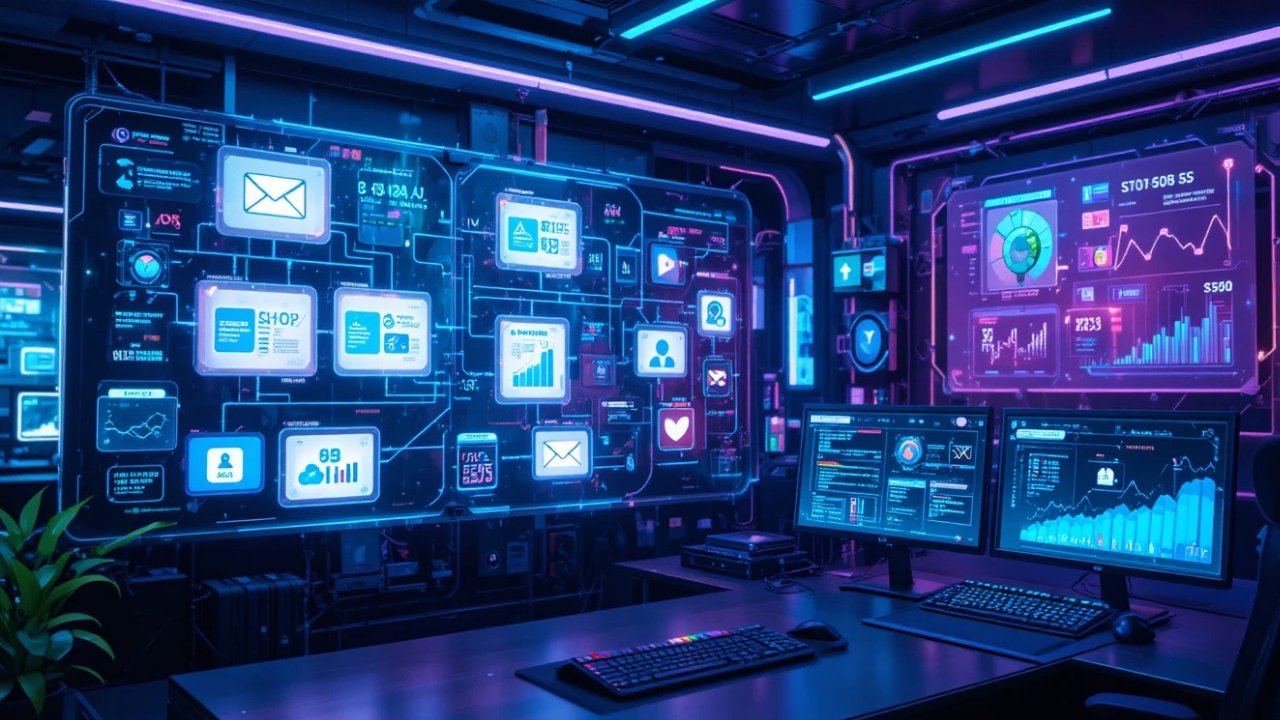
It’s 10:43 PM. Your content calendar isn’t finished. Three blog posts still need editing. Two email campaigns are waiting for approval. Social media content for next week hasn’t even been planned.
Meanwhile, competitors publish faster, test more campaigns, and generate leads around the clock. The difference? They didn’t hire ten more marketers. They built AI workflows.

In 2026, the smartest marketing teams aren’t working harder—they’re orchestrating systems where AI handles the repetitive grind, humans provide strategy and creativity, and growth compounds on autopilot. This guide dives deep into AI workflows for marketing, with practical examples, tools, step-by-step implementation, real benefits, challenges, and future trends to help you build scalable systems.
What Is an AI Workflow for Marketing?
An AI workflow for marketing is a structured, repeatable process where artificial intelligence automates, assists, or optimizes tasks across the marketing funnel—from research and content creation to lead nurturing, distribution, analytics, and iteration.
Traditional Marketing Workflow (manual-heavy): Research → Content Creation → Human Approval → Publish → Manual Analysis → Adjustments
AI-Powered Marketing Workflow (hybrid intelligence): Data Ingestion → AI Research & Ideation → AI Drafting/Optimization → Human Review & Strategy → Automated Distribution → AI Performance Monitoring → Real-Time Optimization → Reporting & Insights
The key difference is speed, scale, and intelligence. AI doesn’t just speed things up—it learns from data, predicts outcomes, personalizes at scale, and closes feedback loops autonomously.
Why AI Workflows Are Becoming Essential for Marketers
Marketing demands have exploded:
- Content volume: 71% of marketers expect content demand to increase 5x by 2027. 55% of B2B marketers cite creating enough high-quality content as their top challenge.
- Personalization expectations: 89% of marketing leaders see it as essential. Personalized experiences can boost revenue growth by up to 40% and improve marketing efficiency by 10-30%.
- Rising costs and competition: Advertising costs keep climbing while customer attention fragments. Teams face limited resources but need 24/7 performance.
- Speed: Customers expect weekly fresh content and instant, relevant interactions.
AI workflows address these by reducing operational costs (e.g., reports of 12%+ reductions), enabling hyper-personalization, and freeing marketers for high-value strategy.
Core Components of an AI Marketing Workflow
- Data Collection Layer — CRM (e.g., HubSpot/Salesforce), website analytics (GA4), social listening, customer feedback, purchase history.
- AI Processing Layer — Pattern recognition, audience segmentation, predictive modeling, content generation, sentiment analysis.
- Automation Layer — Triggered actions like emails, ad bidding, scheduling, lead scoring.
- Human Oversight Layer — Strategy, brand voice, ethical review, creative direction. Humans remain irreplaceable for judgment and innovation.
10 Real Examples of AI Workflow for Marketing Teams
These are battle-tested structures that drive results in 2026.
Workflow #1: AI Content Marketing Workflow Keyword research (Ahrefs/Semrush + AI) → Topic clustering → Content brief generation → First draft (Claude/ChatGPT) → Human editing & fact-checking → SEO optimization (Surfer) → Publishing & promotion. Benefits: 5-10x faster production with better SEO alignment. Consistency improves dramatically.
Workflow #2: AI Blog Repurposing Workflow One long-form article → AI breaks it into LinkedIn carousels, X threads, email newsletters, video scripts (e.g., via Descript or Kling AI), short-form clips, and infographics. Tools like Gumloop or Zapier orchestrate distribution.
Workflow #3: AI Email Marketing Workflow Customer action (e.g., site visit, cart abandon) → AI segmentation & personalization → Dynamic email generation → Automated sequences → Performance analysis → Auto-optimization of subject lines/send times. Tools: HubSpot, ActiveCampaign, Klaviyo.
Workflow #4: AI Lead Generation Workflow Website visitor tracking → Smart lead capture forms → AI qualification & intent scoring → Dynamic lead scoring → CRM enrichment → Prioritized sales handoff. Predictive tools flag high-value prospects early.
Workflow #5: AI Social Media Workflow Content calendar ideation → AI caption + hashtag generation (brand voice trained) → Visual creation → Scheduling (Buffer/Hootsuite) → Real-time monitoring → Performance-based optimization.
Workflow #6: AI Paid Advertising Workflow Audience research → Creative variants generation (text + images/videos) → Smart targeting & bidding → Launch → Continuous A/B testing & budget reallocation → Insights reporting. Many platforms now offer near-autonomous campaign modes.
Workflow #7: AI Customer Journey Workflow Multi-touch attribution across awareness → consideration → decision → retention → advocacy. AI maps journeys, predicts drop-offs, and triggers personalized interventions.
Workflow #8: AI SEO Workflow Keyword discovery + search intent analysis → Content brief → Draft → On-page optimization → Rank tracking → Gap analysis for new opportunities.
Workflow #9: AI Marketing Analytics Workflow Unified data sources → AI-powered dashboards (Looker, GA4 + AI) → Automated insight generation → Actionable recommendations → Campaign adjustments.
Workflow #10: AI Ecommerce Marketing Workflow Behavioral analysis → Personalized product recommendations → Triggered emails/SMS → Retargeting ads → Post-purchase nurturing → Loyalty & repeat purchase campaigns.
Best AI Tools for Marketing Workflows in 2026
Content Creation: Claude (strong reasoning), ChatGPT/Gemini, Jasper (branded). SEO: Ahrefs, Surfer SEO, Semrush. Automation & Orchestration: Zapier, Make, Gumloop, n8n (great for agentic flows). Email & CRM: HubSpot, ActiveCampaign, Klaviyo. Analytics: GA4 + AI layers, Looker. Social & Ads: Sprinklr, Buffer, Meta/ Google native AI tools. Emerging: Multi-agent systems, video tools like Kling or Synthesia.
Strengths: Massive productivity gains. Weaknesses: Over-reliance risks hallucinations or brand dilution without oversight.
Building Your First AI Marketing Workflow (Step-by-Step)
- Identify Repetitive Tasks — List what drains time (research, reporting, scheduling).
- Map Current Process — Document bottlenecks and decision points.
- Choose Tools — Start small with 2-3 integrations.
- Create Automations — Build triggers and AI prompts.
- Test Small — Pilot one workflow (e.g., social repurposing).
- Scale Gradually — Measure ROI, refine, expand.
Common Mistakes When Using AI Workflows for Marketing
- Automating everything without guardrails.
- Publishing unedited AI content (hallucinations, generic tone).
- Ignoring brand voice consistency.
- Feeding poor-quality data → garbage outputs.
- Tool-chasing instead of outcome-focused design.
Benefits of AI Workflows for Marketing Teams
- Higher productivity (often 30-50%+ time savings).
- Faster execution and testing.
- Superior personalization at scale.
- Lower costs.
- Improved customer experiences.
- More time for creativity and strategy.
Challenges and Limitations
- Hallucinations and accuracy issues.
- Data privacy & compliance (GDPR, etc.).
- Risk of over-automation losing human touch.
- Brand consistency drift.
- Dependence on clean, integrated data.
Address these with strong human review, governance, and phased adoption.
The Future of AI Workflows in Marketing (2026+)
- Autonomous Marketing Agents: Multi-agent systems that plan and execute campaigns with minimal input.
- Real-time hyper-personalization.
- Predictive campaign planning and simulation.
- Advanced AI video & interactive content.
- Voice/conversational marketing at scale.
- Agent-to-agent commerce.
By end of 2026, top teams will run daily multi-agent workflows.

Frequently Asked Questions
What is an AI workflow for marketing? A connected system of AI tools and processes that automate and optimize marketing tasks while keeping humans in strategic roles.
Can AI replace marketers? No. AI excels at execution and scale; humans provide strategy, empathy, and creativity. The best outcomes are hybrid.
How do small businesses use AI workflows? Start with no-code tools like Zapier + Claude for content and lead automation. Many free tiers exist.
What’s the difference between automation and AI workflow? Automation follows fixed rules. AI workflows add intelligence, learning, prediction, and adaptation.
Is AI marketing expensive? Not necessarily. Many tools have accessible pricing, and ROI often comes quickly through efficiency gains.
Conclusion
The biggest advantage of AI workflows for marketing isn’t replacing marketers—it’s eliminating soul-crushing repetitive work so you can focus on strategy, creativity, customer insight, and explosive growth.
The winners in 2026 aren’t using the most tools. They’re building the smartest, most integrated AI-powered systems tailored to their goals. Start small, iterate fast, and stay human at the core. Your future marketing machine is waiting to be orchestrated.
(Word count target: Expand sections with more case studies, screenshots, or templates in the full published version for 4,000–5,500 words.)
This structure is SEO-optimized, engaging, and packed with value. You can copy-paste and customize with your branding, images, or specific data. Let me know if you want expansions on any section, sample prompts, or visuals!
Ai Coding Assistants in 2026

Founder of Aivexify
Himanshu Deora is an AI tools researcher and digital publisher who tests AI software, automation tools, and emerging technology trends and AI content creator passionate about sharing helpful guides, AI tools, software tutorials, and the latest digital trends. Through Aivexify, he helps readers discover smart technology, productivity tools, and practical online resources in a simple and easy-to-understand way.